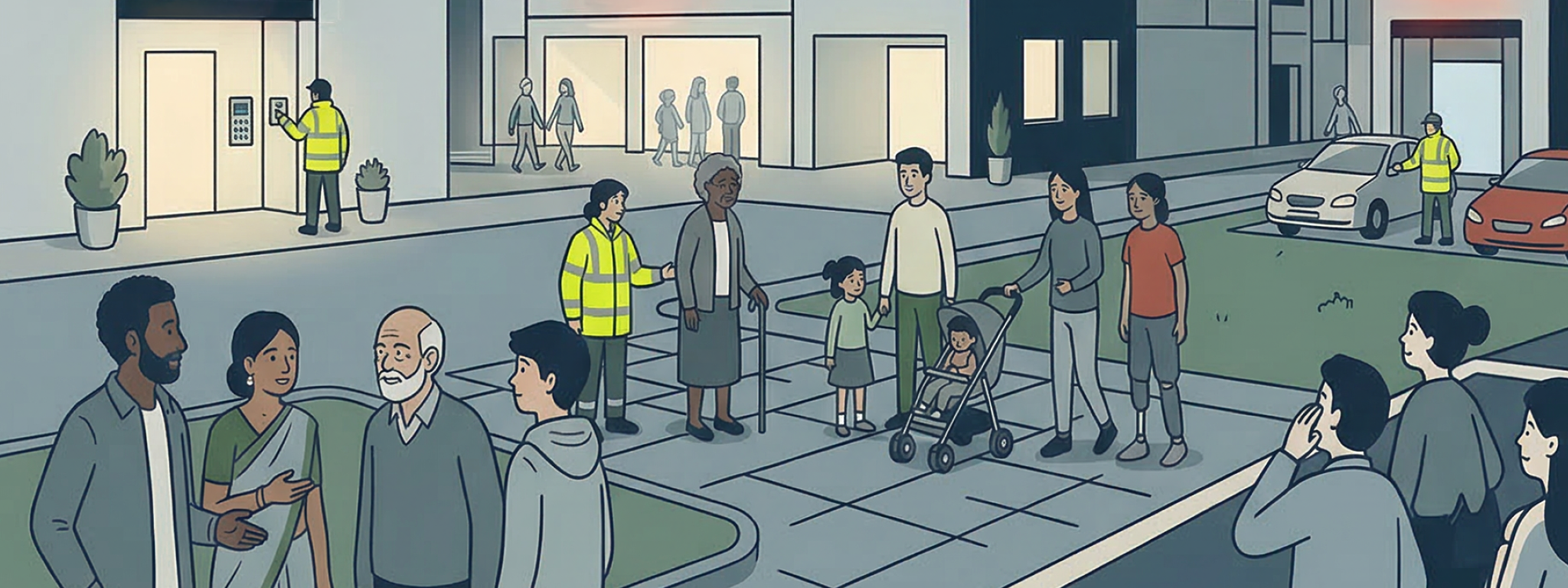
From 6 April 2026, new regulations in England will require responsible persons in certain higher-risk residential buildings to take reasonable steps to identify residents who may need support to evacuate in the event of a fire.
These new Residential Personal Emergency Evacuation Plan regulations, often shortened to RPEEPs, are an important step forward in strengthening fire safety for residents. They are also part of the final recommendations arising from the Grenfell Tower Inquiry to be implemented through legislation.
But while the name may sound technical, the principle behind it is simple. This is about understanding who may need help in an emergency, having the right conversations early, and ensuring the fire and rescue service has the information it needs to act quickly and effectively if the worst happens.
In the latest episode of Built. Managed. Lived., FirstPort’s Head of Technical Fire Safety Patrick Heaney was joined by Andy Frankum, Chair of the National Social Housing Fire Strategy Group, and Dean Dixon, Primary Authority Lead for Hampshire and Isle of Wight Fire and Rescue Service, to explore what the new regulations mean in practice.
A resident-led process, not a one-size-fits-all system
One of the most important themes to come out of the discussion was that this process is entirely resident led.
That matters, because the term “Personal Emergency Evacuation Plan” has caused confusion in the past. In workplace settings, PEEPs are often associated with arrangements where someone is physically assisted from a building by designated personnel. In residential settings, that is not what these new regulations are asking building operators to provide.
As Dean explained, the purpose here is not to create a staffed evacuation system for every building. It is to identify residents who may be unable to self-evacuate and make sure the right information is available to support a rescue response if needed.
In other words, the process is about planning, communication and preparedness, not about creating unrealistic expectations or unnecessary alarm.
For residents, that should be reassuring. The aim is to have a conversation about what support may be needed, if any, in the unlikely event of a fire, and to make sure that conversation is shaped by the person who knows their needs best: the resident themselves.
Why this matters
This legislation exists for a reason. It is rooted in the lessons of Grenfell, where disabled residents were among those who lost their lives because they were unable to evacuate safely.
It also reflects the scale of need across the housing sector. According to the English Housing Survey 2019 to 2020, 54 per cent of all social rented households included at least one member with a disability or long-term health condition. With around 4 million households in the sector, that equates to approximately 2.16 million households. That is not a marginal issue. It is a significant part of the resident population.
While the likelihood of any individual resident experiencing a fire remains low, the consequences can be devastating, particularly for those who may not be able to evacuate quickly or without support.
That makes this more than a compliance exercise. It is about putting residents at the centre of fire safety planning and recognising that effective fire safety must work for everyone, including people with mobility issues, sensory impairments, cognitive impairments or other circumstances that may affect how they respond in an emergency.
As Andy put it, the housing sector’s duty is clear: to protect residents. That means listening, learning and working with people to understand what they may need, rather than making assumptions.
Which buildings are in scope?
The regulations apply in England to:
- residential buildings over 18 metres in height with two or more residential units, regardless of evacuation strategy
- residential buildings between 11 metres and 17.9 metres, or over five storeys, where a simultaneous evacuation strategy is in place
This is significant because it broadens the focus beyond the tallest buildings and reflects a more risk-based approach to resident safety.
It may also be the start of a wider shift. As Dean noted, legislation often begins with the highest-risk settings, but over time it can expand. The direction of travel is clear: improving life safety for residents through better planning and better information.
What information is actually needed?
A key point from the discussion was that the information required is high-level and practical.
This is not about collecting medical histories or intrusive personal data. Responsible persons and fire and rescue services do not need to know diagnoses, detailed conditions or anything unrelated to evacuation.
What they do need to know is:
- whether a resident may need assistance to evacuate
- what type of assistance may be needed
- where that resident is located within the building
That might mean understanding that someone cannot hear an alarm clearly, may struggle with stairs, may need guidance because of a visual impairment, or may find it difficult to respond quickly in an emergency because of a cognitive impairment.
The focus is on the practical implications for evacuation, not the underlying personal details.
It is not only about physical disability
Another important takeaway is that this process is much broader than many people assume.
When people hear the phrase evacuation support, they often think first about wheelchair users or residents with visible mobility issues. But the conversation highlighted that support needs can arise in many different ways.
A resident may be physically able to move, but unable to hear an alarm. Someone else may have sight loss and need direction. Another person may have a cognitive impairment that affects how they understand or respond to risk.
The regulations also apply to children where relevant, and there are safeguards for residents who may need support in participating in the process itself. In some cases, a legal representative may act on someone’s behalf. In others, a resident may choose to involve a trusted person in meetings or discussions.
That flexibility is important because it recognises that support needs do not always fit neat categories.
What does the process involve?
Once a resident is identified and agrees to participate, the next step is usually a person-centred fire risk assessment.
This is a practical discussion about the resident’s circumstances, their home, and what might help them stay safe or evacuate if needed. From that, an Emergency Evacuation Statement can be developed setting out the agreed support needs in a simple, usable way.
The relevant information is then made available to the fire and rescue service, typically through the building’s secure information box and, in some cases, through electronic systems as well. Fire services may have slightly different operational preferences, which means responsible persons must understand local arrangements as well as national requirements.
Why the fire service needs this information
For fire and rescue services, this information is not administrative. It is operationally critical.
Firefighters attend incidents and make dynamic risk assessments in real time. They need to know where the fire is, how it is developing, and where people may be at greatest risk. If they also know that a particular resident on a nearby floor may need help to evacuate, they can plan accordingly and deploy the right resources earlier.
That can make a significant difference.
A resident with hearing loss may need to be alerted and directed. A resident with mobility impairments may require additional firefighters or specialist equipment to get them down the stairs safely. Knowing that in advance helps crews prioritise, respond faster and use their resources more effectively.
As Dean explained, the fire service is there to save lives. The better the information it receives, the better it can do that.
What counts as “reasonable endeavours”?
One area that is likely to develop over time is the meaning of “reasonable endeavours”.
The regulations require responsible persons to make reasonable efforts to identify residents who may need support, but how that looks in practice will vary depending on the building, its management arrangements and the residents who live there.
That might include:
- direct communication with residents
- information on resident portals
- leaflet drops or letters
- posters and notices
- support from on-site staff such as scheme managers or concierges
- door knocking or follow-up contact
- discreet questionnaires or consent-based engagement
The key is consistency, proportionality and an auditable process. Responsible persons should be able to show the steps they have taken, the methods they have used, and how they have approached resident engagement over time.
This is not a one-off exercise. The expectation is that the process is reviewed when someone moves in, when a support need becomes known, and then at least annually unless something changes.
A challenge for the sector, but the right one
There is no doubt that this creates operational challenges, especially for larger organisations with buildings across different fire and rescue authority areas or across different UK nations.
But the panel was clear that the answer lies in collaboration, shared learning and resident focus.
The scale of disability and long-term health conditions across social housing alone shows why this cannot be approached as a niche compliance issue. For many landlords and managing agents, this will touch a meaningful proportion of their residents. That is exactly why the sector needs practical, person-centred processes that are consistent, proportionate and built to last.
This is new regulation. Some organisations are further ahead than others. Some already have strong person-centred fire risk processes in place. Others are only just beginning. What matters now is that good practice is shared, processes are tested, and the spirit of the regulation is upheld.
That spirit is simple: listen to residents, plan around real needs, and put life safety first.
The most important takeaway
The clearest message from the conversation was also the most human one.
This is not about creating fear. It is about creating reassurance.
It is about making sure that residents who may need support know that there is a process designed around their safety, that it is based on consent, and that their voice is central throughout.
For landlords, managing agents and responsible persons, it is a reminder that fire safety is not only about buildings and systems. It is also about people, and about understanding how different residents may experience risk in different ways.
And for the fire service, it is about having the right information to make life-saving decisions quickly when every second counts.
In the end, that is what this is all for: making sure more people can get to a place of safety.
Listen to the Built, Managed, Lived. podcast
Hosted by FirstPort, the Built, Managed, Lived. podcast brings together residents, policymakers, developers, engineers, and industry experts to explore how homes are designed, run and experienced in real life.