The UK’s later living sector is entering a period of profound change.
For years, much of the conversation has centred on one question: how do we encourage more people to move? It is an understandable focus. Demographic trends are clear, housing pressures continue to mount, and the benefits of purpose-built later living communities are increasingly well understood within the industry.
Yet concentrating solely on demand risks overlooking something equally significant. The sector itself is evolving.
The commercial models that shaped retirement housing for decades are being challenged. Resident expectations are changing. Technology is transforming both operations and customer experience. New forms of tenure are emerging, while policymakers continue to debate ownership structures that could fundamentally reshape residential management.
Taken together, these developments point towards a sector that is becoming considerably more sophisticated than the one many people still imagine.
The future of later living will not simply be determined by how many developments are built.
It will be determined by how successfully the industry adapts to changing expectations around flexibility, affordability and experience.
The conversation around affordability needs to mature
Few topics generate more debate within later living than service charges.
For many prospective residents and their families, they represent the single biggest barrier to moving. Headlines often reinforce the perception that service charges are simply an additional cost attached to retirement housing, encouraging comparisons with living in a traditional family home.
That comparison is rarely straightforward.
A later living community is not simply an apartment with communal corridors. It is an operationally intensive environment that requires professional management, ongoing maintenance, insurance, compliance, communal utilities, landscaping, security and, increasingly, a programme of activities and services designed to support residents’ wellbeing.
Those costs are visible because they are brought together into a single service charge. By contrast, the costs of maintaining a traditional home are often spread over many years and paid in isolation. Roof repairs, gardening, insurance, heating, external maintenance and emergency works rarely appear as one monthly figure, yet collectively they can represent a significant financial commitment.
That does not mean affordability concerns should be dismissed. It does mean the conversation should become more sophisticated.
The question is no longer whether service charges exist. It is whether the value they deliver is properly understood.
The industry has an opportunity and arguably a responsibility to explain that value with greater clarity and transparency than it has done historically.
Flexibility is becoming the new competitive advantage
Perhaps the most significant commercial shift taking place across the sector is the move away from a single ownership model.
For decades, purchasing a retirement apartment was regarded as the default route into later living. Increasingly, operators are recognising that retirement itself is becoming more diverse than previous generations anticipated.
Some people still want the certainty of home ownership. Others value flexibility above permanence. That change is driving innovation across the market.
Deferred management fees are evolving to create greater certainty around ongoing costs. Some operators are introducing index-linked charging structures to improve predictability for residents living on fixed incomes. Rental models continue to expand, offering an alternative for those who want the lifestyle benefits of later living without committing to ownership. Shared ownership is opening the market to residents who might previously have found the financial barriers too high.
Taken individually, these innovations may appear incremental.
Collectively, they represent a fundamental shift in how later living is being positioned.
Rather than asking residents to fit a single commercial model, operators are increasingly adapting their commercial models to fit the needs of different residents.
That is a significant evolution.
It also reflects a broader trend across the housing sector, where flexibility is becoming every bit as valuable as ownership.
Technology is changing far more than buildings
When technology is discussed within residential property, attention often focuses on operational efficiencies.
Smart meters, energy management, predictive maintenance, digital resident portals. All of these innovations matter.
Yet within later living, technology has a much more profound role to play. It is quietly changing what independent living actually looks like.
Digital emergency response systems are replacing traditional alarm infrastructure. Wearable devices are allowing residents to summon help discreetly whenever it is needed. Remote health monitoring and virtual GP appointments are reducing reliance on physical appointments while giving residents quicker access to healthcare professionals. Improvements in building technology are reducing energy consumption and helping operators manage increasingly complex developments more efficiently.
None of this removes the human element that sits at the heart of later living.
Instead, it enhances it.
Technology enables support to become more responsive without becoming more intrusive. It allows residents to retain their independence while providing reassurance both to them and to their families.
At the same time, improved operational efficiency helps manage long-term running costs, creating benefits for both residents and operators.
Technology therefore isn’t simply improving buildings.
It is redefining the resident experience.
The ownership debate cannot ignore operational reality
As discussions around commonhold continue to gather momentum, the later living sector finds itself in a unique position.
The principle of greater resident ownership and control is an attractive one. In many conventional residential developments, commonhold has the potential to simplify ownership structures and provide greater transparency.
Later living, however, presents a more complex picture.
Many developments contain restaurants, wellness facilities, communal lounges, landscaped gardens and extensive shared amenities. Some provide integrated care services or wellbeing programmes that require continuous professional oversight.
Managing these environments demands expertise, long-term financial planning and operational consistency.
Equally important is understanding why many residents choose later living in the first place.
For a significant proportion, the appeal lies in removing responsibility rather than increasing it.
They are choosing to step away from the complexities of building management, not assume greater control over them.
That does not mean commonhold has no future within later living. Simpler developments may adapt successfully, particularly where residents already play an active role in governance. More operationally intensive communities, however, are likely to require different solutions.
The debate therefore should not focus on finding a single model that fits every development.
It should focus on recognising that different communities have fundamentally different operational requirements.
Property management is becoming hospitality
Perhaps the most interesting transformation taking place within later living is one that extends well beyond legislation or commercial structures.
The role of the managing agent itself is changing.
Historically, success was measured by compliance, maintenance standards and financial control. Those responsibilities remain every bit as important today.
But they are no longer enough.
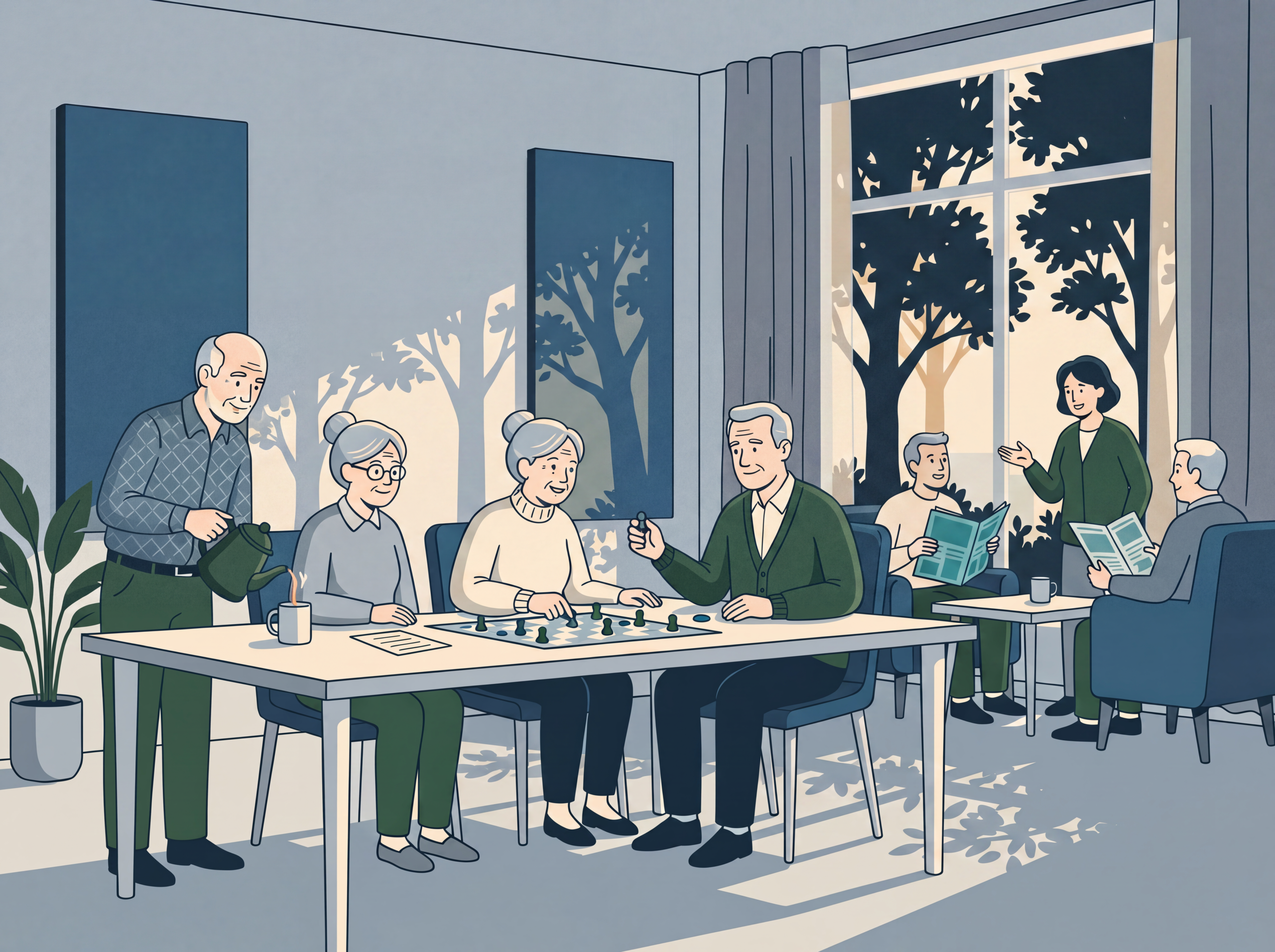
Residents increasingly expect operators to deliver experiences rather than simply services.
The parallels with other operational real estate sectors are striking.
Build-to-Rent has demonstrated that resident satisfaction drives long-term value.
Purpose-built student accommodation has evolved from providing rooms to creating communities.
The hotel sector has long understood that service quality defines the customer experience far more than bricks and mortar. Later living is following a similar path.
Development managers are becoming community leaders as much as building managers. Their success is measured not only by operational performance but by the strength of the communities they help create.
That represents a significant cultural shift. Buildings may attract residents. Communities persuade them to stay.
The next chapter
The later living sector has never stood still.
It has quietly evolved through changing demographics, new technologies, shifting consumer expectations and increasingly sophisticated commercial models.
The challenge now is ensuring that evolution continues.
Future success will depend less on delivering more apartments and more on delivering greater confidence. Confidence that costs are transparent. Confidence that communities will remain vibrant. Confidence that support will be available when circumstances change. Confidence that residents retain genuine choice throughout later life.
Those who succeed will understand that they are no longer competing solely on location, specification or amenities.
They are competing on experience.
Ultimately, the future of later living will not be defined by the buildings the sector constructs. It will be defined by the lives those buildings make possible.
The industry’s opportunity is no longer simply to respond to demographic change.
It is to lead it.
Because if later living can continue to combine independence, flexibility, community and operational excellence, it will become far more than a successful residential asset class.
It will become one of the defining components of Britain’s future housing landscape.
Listen to the Built, Managed, Lived. podcast
Hosted by FirstPort, the Built, Managed, Lived. podcast brings together residents, policymakers, developers, engineers, and industry experts to explore how homes are designed, run and experienced in real life.