28 min 10 sec
Episode 8: Inside the evolving world of later living
Exploring the benefits, challenges and future of independent later living communities.
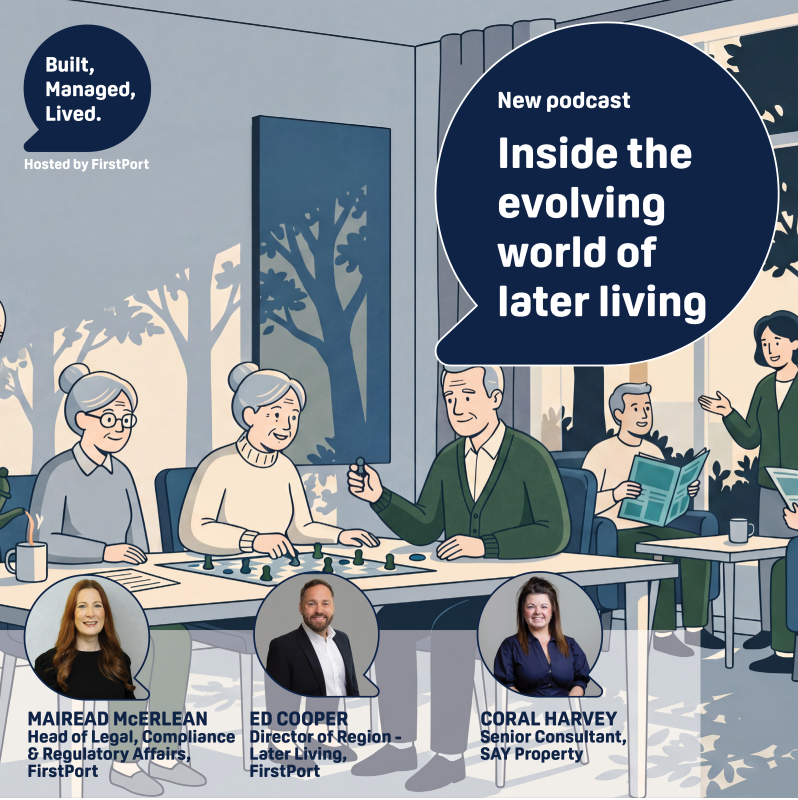
FirstPort's Mairead McErlean and Ed Cooper are joined by Coral Harvey, Senior Consultant at SAY Property Consultants, to explore the later living sector. Together, they challenge common misconceptions about retirement communities, examine key issues including affordability, service charges and resale values, and discuss how technology, new housing models and changing consumer expectations are shaping the future of independent later living.
Key Takeaways
Read more about the future of the later living sector: The next evolution of Later Living: Why experience, flexibility and community will define the sector

Head of Compliance and Regulatory Affairs, FirstPort
Mairead is Head of Compliance and Regulatory Affairs at FirstPort, where she provides strategic guidance on current and emerging legislation and regulatory frameworks.

Director of Region, FirstPort
Ed is Director of Region – Later Living at FirstPort, leading the teams that care for the 60,000 later living properties under FirstPort’s management

Senior Consultant, SAY Property
Coral is a Senior Consultant at SAY Property, with more than 10 years' experience in residential property management, specialising in the later living sector. She also serves as a board member of the Association of Retirement Housing Managers (ARHM).
Mairead: Welcome to Built Manage Lived. I’m your host, Mairead McErlean, head of Legal, Compliance and Regulatory Affairs at FirstPort. In this episode, we’re exploring the world of later living and how this model of communal living helps residents live independently in thriving, like-minded communities. We’ll unpack some of the common misconceptions, discuss challenges facing the sector, and look ahead to how later living could evolve in the coming years. I’m joined today by Ed Cooper, who heads up FirstPort’s management portfolio of 60,000 later living properties, and Coral Harvey, property consultant and later living specialist at Say Property Consultants. So welcome both of you.
Coral: Thank you.
Ed: Thank you for having us.
Mairead: Do you want to just give us a little bit of background on how you come to be sat on the sofas today?
Coral: Yes. So my name’s Coral Harvey. I work for Say, who are a property consultancy firm based in Central London. I’ve worked in the retirement sector now for over 10 years, actually starting my career at FirstPort Retirement, initially as a purchase ledger clerk, and then worked my sort of way up, if you like, through lots of different roles, finishing as one of the service charge team leaders. Since then, I’ve worked for other retirement property management firms, and then for the last 18 months, specialized in later living with Say.
Mairead: Thanks, Coral. Ed, what’s your background?
Ed: Yeah. So I’ve, I’ve been with FirstPort within the later living space for about eight years now. Prior to that, I worked in health clubs, and one of the last projects I did was a health club for retired people. So it all kind of linked together, and it was about making spaces for older people to feel seen and visible and have a place within society, so it all links together through my, my journey. But yes, I’ve managed many different portfolios in our space, dealt with lots and lots of communities along the way, and, uh, built up a lot of, uh, I guess, love for the sector. Uh, it’s, it’s special to me. So yes-
Mairead: Excellent
Ed: … that’s my journey.
Mairead: Well, Ed, that leads me really nicely into the, the first thing that I wanted to ask you about. So for people who aren’t familiar with later living or who might be considering moving to a later living property, can you explain the format, how the developments are managed, and how they differ from, you know, an apartment in a normal block of flats?
Ed: Yeah, of course. I think it’s important to kind of start this section with understanding that a later living property is not a care home. It’s its own housing sector. It’s one of the biggest barriers for people moving into a later living property. A kind of care home is a very different space. At the core of this kind of housing, you’re still a leaseholder, you’re still an owner. You might rent your property. You have your own apartment within a block. Um, generally, you may see a mixture of houses or, uh, apartments within that space. Where it differs from the kind of open market space is how the property’s used. So you’ll see bigger communal spaces. You’ll see areas where people can almost have an extension of their living room and get together with their friends. And then you tend to see a, an environment where you can age well and you can live independently for longer. So you’ll have maybe onsite staff that help you with day-to-day cleaning, laundry services, maintaining an independent life. And as you kind of work your way through the different types of retirement properties and later living properties, there’s different segments of the market for your kind of budget, your needs, and they all have a space within that world. From a management perspective, later living properties are there to try and take out some of the, I guess, the sweat of living in your own home. So you, you don’t have to maintain the garden anymore. You don’t have to worry about the window cleaner. You don’t w- have to worry about fixing the roof. That’s what your managing agent or your property manager would do. And for a retired person, that’s important. Sometimes they wanna not have to worry about the house anymore. They can just enjoy their retirement and live well. We will look after buildings primarily, but the side part of it is that you’re also trying to build a community for people to live in. So you’ll have an onsite manager, and their job isn’t just, you know, get the windows clean, fix things that are broken. They’ll be introducing people to each other. They’ll be building a social environment that essentially helps you to age well.
Mairead: And Coral, what are the misconceptions around later living?
Coral: So I think one of the misconceptions is that later living is for older people, and it’s that next step towards care, like we’ve touched on, whereas actually, I would say it’s completely the opposite. It’s about embracing the facilities, the community element, and it’s a place where people can keep young and introduce care as and when it may be needed, rather than move into sort of a permanent care setting. And then I would say that a second misconception is around service charges and that they present poor value, whereas actually they, they present the operational costs of that building. So we’ll often hear from owners that think that that service charge is simply the profit that’s going to their management company. Actually, it’s the cost of the insurance, the utilities, running their facilities, and I think there’s probably some education to be done around that. Additionally, owners have protections with service charges, so anybody that pays a variable service charge is automatically protected by the Landlord and Tenant Act. We also have two codes of practices in the industry. We have one that is specific to integrated retirement communities, and we have one specific to the sheltered retirement communities, ARHM That code of practice is upheld by the Secretary of State, so actually it’s a really strong document that if residents wanted to challenge the reasonableness of their service charge, that is their first port of call that they could go to.
Mairead: So you mentioned that the code of practice is upheld by the Secretary of State.
Coral: Yeah.
Mairead: So this isn’t a, an optional code, it’s something that all operators must abide by?
Coral: So retirement operators would opt in to becoming an ARHM member, but if they are a member of the trade body, then yes, they are obliged to follow the code of practice.
Mairead: So that’s something that people who are looking at retirement communities should look out for.
Coral: Yeah, absolutely. It gives it an extra level of sort of protection and security.
Mairead: Ed, anything to add to that?
Ed: So I think the codes of practice are really beneficial because they are very resident-driven, they’re very resident-led in how you should act, how you should treat each other. And I think there is a bit of a misconception that older people’s housing is kind of just done, it’s a product that just happens. And actually, the residents within a later living community, there is a lot more engagement, they’re a lot more involved within how their property’s managed. And almost they see the benefit of common hold in real time because they’re asked around expenditure and what we wanna do in the property. The benefit of the communal space is that you’ve got space to meet, you’ve got space to spend time, and we’ll see regularly resident meetings with agents in the, the communal space to try and keep them informed and, and update them on what’s going on. But certainly that code of practice helps in just being transparent and being honest around what you need to do, and keeps everyone on the same playing field, which I think is important in the sector.
Mairead: You started by saying that it’s different from a care home. So it feels a little bit like the concept isn’t entirely clear in this country. How do attitudes and cultures towards later living differ between the UK and other countries, Coral?
Coral: So I think the UK has historically been much slower to embrace the later living sector, and particularly if you compare to countries like Australia, New Zealand, and the US, where moving into a later living community is actually viewed as such a positive lifestyle choice, and almost really aspirational. I think one of the barriers we also face here is actually the cost of moving, and particularly in your later years where you’re also considering things like inheritance tax, it puts people off making that downsizing move. Whereas we know that in other countries like Australia, they have developed tax-friendly schemes specifically to encourage people to downsize into retirement settings.
Mairead: That’s interesting. So what are the benefits of the later living model in this country, and how does it help to tackle things like isolation and loneliness?
Coral: Well, I think the benefit has to be the community, and then you have the safety and security too. So you’ll often have an on-site team that are there to support the owners, and actually, owners can get as involved, as little or as much as they want. There’ll be sort of activities that might be put on, and events. Have you got anything else to add to that?
Ed: I think there’s a lot of family homes that are tied up at the moment, and have been the family home for a long time for retired people. They’ve seen their kids grow up there, they don’t wanna move, but actually that’s the housing stock that the rest of the market needs, so it creates a little bit of a bottleneck as well. And our policy around kind of later living housing at the moment and the way it’s perceived in the country, it stops people from almost moving when they should and when it’s right. In, in other countries, certainly people move much earlier and much younger into a, a later living property, and it does then free up the market, it allows people to move through more swiftly. But yeah, I agree, I think the beauty of a later living development is that you’re not isolated, you have people around you, and actually you can be as involved or absent from that community as you want. It’s not a forced kind of fun, I guess. And that’s the big thing. It’s still your home, you’re still independent. It’s just that you’re a little bit older than the average bear, I guess.
Mairead: Ed, you said that community is central to the later living model, and Coral backed you up with that. What different types of later living schemes are out there, and what should people be thinking about when they’re looking at a home in a later living development?
Ed: Yeah, the market, it’s got quite a few areas now. You have your traditional sheltered housing, which is a kind of entry-level product, I suppose, where you’ll have a communal lounge and apartments above it, and kind of a self-managed community. They will arrange their own events, they’ll have this space. That then works its way through to more premium facilities. So you may have sites that have got like a dedicated community manager. They will build an activity program that is everything throughout the week, and it’s almost like being on holiday. You’ve got a program that you can see for the week. “This is where I’m gonna be at 10:00 AM. That’s where I’m gonna be at 12:00 PM,” and it’s led through that lens. And then that will work its way through to the kind of high-end retirement villages that you often see, where they have a restaurant, they have a gym, they have a pool, they have the next level of facility and the community elements bolted on. I think the piece with any later living property and decision to move, this is about the right community for you, and it’s also the right community for your budget, because retirement is not a kind of five-year journey. We have residents that have lived there for 30 years. It can be quite a long period of time that you spend at the property. But it’s often the last move that you make, so you want it to be the right one. But, you know, the communal activities that you see, that is what tends to sell a property, and it’s why people buy. Rather than lots of glossy facilities and fancy swimming pools or gyms, it’s more about the people and how they interact rather than the facility itself. But the market’s really changing, which is Coral’s world
Mairead: Oh, Coral, tell us about that.
Coral: Yeah. So as Ed started to talk about, we have what we refer to now as integrated retirement communities. So these are the settings that have the much wider amenity offerings, the 24-hour care provision in place, the onsite restaurants, the spas, the swimming pools, et cetera. But actually running those operational buildings is a huge cost and often can’t run with a variable service charge mechanism. So what we’re seeing now are operators introducing an index-linked fee, so owners have complete certainty over the costs that they’re going to pay during their ownership. But the trade-off with that is that they’ll pay a larger deferred management fee at the end, so when they sell the property in the future.
Mairead: That’s a really interesting point, Coral, because some of the services that you are describing sound great. And I noticed that you said there, like, a provision of 24-hour care. So is this a concept where you could move into a property when you’re really quite fit, and if your care needs change over time, you can increase the level of care you get without leaving your home?
Coral: Yeah. It’s absolutely that. So what an integrated retirement community tries to do is actually offer that whole continuum of care so you shouldn’t have to leave the village. That is your final home, if you like.
Mairead: That must sound like an incredibly attractive prospect for a lot of people-
Coral: Yeah
Mairead: … being able to live their final days in their own home. But you have really gone straight in there and tackled the big issue, is it’s expensive.
Coral: Yeah, it’s really expensive. And I do think that actually there is a misunderstanding of service charges when people first purchase into retirement properties, whether that’s an integrated retirement community or what we refer to as the sheltered retirement housing. A lot of the time when families or owners are downsizing, they have come from maybe a large or a freehold home and never lived in a leasehold property. So actually, all of the legislation that follows that, the conditions, you know, the mandatory service charge that is payable for those operational costs is completely new territory and can be quite overwhelming when a lot of our owners will have a fixed income that is unlikely to increase at the level of a service charge will.
Mairead: And that’s reflected in some news stories that we’ve heard recently around difficulties with selling and buying later living units. So I think we do need to talk about that. Ed, do you want to go first?
Ed: Yeah. I think it’s one of the biggest challenges that the sector faces. Unfortunately, in this category, you buy new, and often the asset depreciates. You don’t see that very often in the housing sector. Where that’s driven from is sometimes supply and demand but also the fear of service charges, that, you know, service charges increasing, having all these facilities with a small number of properties to contribute, and those rising in price ahead of a pension. So it is a challenge. The sector as a whole has a challenge. Where integrated retirement communities are starting to come up as a new sector, there are different mechanisms to help to try and keep the service charge costs down. There are some operators looking at buyback schemes and kind of how do we retain the values within the site. But it, it is a challenge. And the onward piece around being left with an asset that has a service charge also worries people. You don’t want to leave your children to have to deal with your estate and a, a cost that could continue to be incurred for a long period of time. So the sector is, is getting more agile to it. There are lots of incentives in place to try and, you know, put in support, put in holds on charges, try and allow it to be deferred, as you mentioned, Coral, on exit. And that is a, a shift that the industry’s making to try and deal with that fear of service charge.
Mairead: What about renting? Is there a market for renting?
Coral: I think renting is really up and coming in the retirement sector.
Ed: Yeah.
Coral: I think it actually could be one of the way forward because what we find is families are so concerned about the ongoing costs. Maybe if they’re having to deal with the affairs of the estate, that actually if you were to rent, then your, your tenancy agreement would come to an end once that owner has vacated the property. So I can see some real benefits to it, particularly now we have renters’ rights that have come in earlier this year that has far more protections. I think the, the issue we, we are facing is, is almost the stigma of renting for that generation or the current generation that would be moving into retirement properties today because they’ve worked so hard to buy their freehold home. They’ve always owned their home, you know, for their lifetime. And actually, they might sort of approach renting as almost dead money rather than seeing that there actually can be some benefits to it.
Ed: I think the, the rental market now, it’s about 15% of the units that we manage are rented. So it is growing, and it grows year on year. Interestingly, those rented units, you see people able to age in place a little bit better because they have more money available for additional care or additional support because it’s not all tied up in, in the flat itself. So there is that flexibility. And we see sometimes people moving city to city when they’re renting, and they try somewhere else, try somewhere new. It’s not as fixed, which is… I think it has removed a little bit of that this-is-my-last-move fear because they’re free to do what they want to do.
Coral: And I think just on your point there, that it gives it a level of flexibility. That’s so important because you might look at a retirement property and think, “This is absolutely for me and I want to embrace the community,” but six months in find that actually it’s not quite for you. And if you’re fixed in a property, then we know we have this resale challenge, whereas with renting, you have that flexibility. You could move somewhere.
Mairead: I thought the point that you made about that if you’re renting and you’ve sold your freehold home, so you’ve got a pot of money in the bank, and you can use that to buy additional services was quite interesting in terms of affordability. What other options are there for addressing those affordability concerns?
Ed: There’s a rise, actually, of shared ownership properties now. So there- there’s a specific fund that the government set up for older people where they’ll contribute a- a percentage of the ownership as well to try and keep costs down. But there is a rise of shared ownership properties where you part rent, part own. It has its challenges because you don’t always want a service charge and a rental cost, but generally it keeps both elements down. And then there is a rise of kind of build-to-rent properties coming as well, where it is purely built, the whole block is rented. A couple of operators have set up now as a single entity, and those are seeing the kind of student living, co-working spaces that we’ve seen in the rest of the market coming through to later living world, which is quite an interesting model for those communities.
Mairead: We’ve talked a lot about how this landscape is changing. Let’s talk a little bit about the geography of that, because there’s a real kind of perception in the UK of there are, you know, almost entire towns of later living communities, and they tend to be kind of coastal. Is that right? Or could you find a later living community within, say, 10 minutes drive of any town or city in the UK now?
Ed: Yeah, I think things have really changed, actually. I think there is a much wider spread now of later living communities, and they are all over the country rather than being kind of retirement town-focused or South Coast-focused as it maybe used to be. There’s definitely still pockets and areas of the country where there are more retirement units. Tends to be further down south. A couple of the big builders were based down there, and, and I think they built where they know. But as I drive around now and I kind of visit different towns and there is a later living property pretty much every town I visit, and I see them cropping up here, there, and everywhere. And I think that’s generally where it’s getting to now. You can retire anywhere in the country.
Coral: Yeah, I can echo that. So I travel around to lots of retirement properties around the UK now. We do tend to see more that are being sort of purpose-built near transport links, maybe the local hospital, so that actually you don’t have to necessarily be able to drive to live in these retirement communities. But yes, all around the country.
Mairead: We’ve talked a lot about the kind of different formats of communities and how those communities are managed. We’ve talked about service charges. I’m going to come to Coral and ask her about one of my pet subjects. How will commonhold look in a retirement or later living community?
Coral: Well, I think, um, it’s a big question [laughs] that you’ve asked. Commonhold, we know, has the potential to offer greater resident ownership and control, but particularly in later living developments where they have these complex services, like we’ve talked about, the swimming pools, the spas, and elements of care and wellbeing services. Commonhold is gonna need such careful consideration to be able to work in practice. I also have to acknowledge that a number of owners will have moved into these later living communities to have somebody else take over the responsibility of managing their building and not take on that responsibility themselves. So I think certain parts of the sector, predominantly the integrated retirement community, commonhold isn’t going to work, but there are other areas of the sector, like the sheltered retirement communities, where actually commonhold is gonna be very similar to what we see with RMCs or, or RTM companies today. So I do think, again, with some consideration, it will work in practice, but there needs to be a distinct difference between the buildings that have these complex amenity areas and spaces to manage versus the standard residential blocks that actually they are no different to any other block other than there is a condition that they must be over 55 to live there.
Mairead: Thanks for that, Coral. Ed, I’m going to come to you because you work north of the border. So in Scotland, there’s already a system that is not dissimilar to commonhold. How does that work for later living communities there?
Ed: Interestingly, it’s actually very similar in how they’re operated. So, you know, the buildings are kind of built in the same way. You still have a service charge that’s levied and, and managed through. Where I think the difference is, is that the leaseholders feel a little bit more empowered because they’re owners. They’re not leaseholders anymore. They’re owners over in Scotland, and each of them are the owner of that building rather than there being a standalone freeholder. So they feel a bit more in control of the asset. But actually, the day-to-day management is very much left to the property factor. They will keep the building safe, they’ll maintain the standards, they’ll manage the funds, and they do all the same things you do with a leaseholder or freeholder in, in England or Wales, but it’s just that feeling of you continue to own your property. And we talked a little bit earlier around that fear of buying a leasehold property and losing your freeholder title or status. That’s a barrier that just doesn’t exist in Scotland with the, with the way that it’s managed up there. But from us, it kind of day to day, very much the same.
Mairead: We’ve talked about service charge and that invariably the more services you have-
Ed: Yeah
Mairead: … the more expensive the cost of providing those services become. How are new technologies and things feeding into that, and will they have an impact of perhaps moderating service charges over time?
Ed: Yeah, they’re having a real impact. I think back to kind of 20, 30 years ago when a lot of buildings were built, and you’d have an overnight manager, you’d have a daytime manager, you’d have lots of people on site. Where buildings are being built now with an integrated emergency call system, and that system is completely kind of autonomous. It doesn’t need anyone to run it. It’s monitored throughout the day, and if someone needed help, they can get it quite quickly. But that type of system is improving year on year with the kind of gains that technology has. And we’re seeing now people are able to age in place longer and further because you can add technology to it. So if you’re at risk of falling over, your system can sense that and call an ambulance for you rather than you needing a warden or someone to come and find you. I think over time, the rise of online GPs will be massive and will really help the sector because we talked a bit about hospitals being nearby and amenities, and it’s often, “Well, I’m near to the doctor so I can get there quickly.” That will only boost availability as those appointments come through. And we’re seeing far more Efficient services coming through with technology. I’m sure in some of the communities you’ve seen, Coral, there’s lots of new things coming out that are making it easier to manage and cheaper, hopefully, for residents.
Coral: Yes, I would say so. So definitely just energy efficiency generally. I know that we’re seeing solar in an awful lot of buildings now as almost a standard, but that just didn’t exist a few years ago. Whereas now a new retirement property is, is almost certain to have some sort of solar element to reduce utility costs, especially where you’ve got the spas and the swimming pools on site. Utility costs can be a huge consideration at this part of the service charge. And then to echo what you said, definitely the provisions where there are more care services in place, we’re starting to see virtual appointments used more so, and where in the past we have the old-fashioned pendants, they have all been changed now to be much more discreet. So owner to owner, you wouldn’t realize that somebody actually has almost got that care provision at hand 24/7 because it might be now a watch or a bracelet.
Mairead: Gosh, that’s really clever.
Coral: Yeah.
Mairead: And finally, a question for both of you. What advice would you give to someone who may be considering a later living property for the first time? Ed, I’ll come to you first.
Ed: I think find a property in a town that has everything you need is one of the big considerations, and also trying out the community before you buy. So if there’s the opportunity to go and have food on site or speak with residents that live there and get a feel for the community, that is really important.
Mairead: Coral?
Coral: I think, like you said, it’s a focus on the lifestyle that you’re looking for and not just the property itself. Try and visit several different communities to get a feel for how they all run operationally, but also ask lots of detailed questions. So make sure you’re informed about how the service charge works up front. Is there a deferred fee that they might need to consider, or their family would need to consider in the future, and what the management arrangements are.
Ed: I think the family point’s really interesting because often your children find your property in your retirement, and it can sometimes be their decision rather than yours. It’s independent later living, so being involved in that decision-making process, being part of it, you going and experiencing it rather than being forced into it is probably important, too, ’cause I think that’s a big barrier we have at the moment is the family making the decisions rather than the individual.
Mairead: Interesting. Well, thank you both so much for coming to talk to me today. It’s an area where the, the population is aging, so change is invariably going to come. Social care is so high on the agenda at the moment, and you’re telling me that a later living community can, for some people, defer the need to have social care. So that sounds quite exciting. It’s definitely given me a different outlook on later living. So thanks very much, and that’s all from us. Until next time.
Be part of the conversation
Have a perspective on how homes are designed, managed or lived in? We’re always looking for new voices to join the conversation.
Explore our latest conversations about residential property management
Never miss an episode
Join us on Spotify and Apple Podcasts for fresh conversations, stories, and insights.
Get in touch to learn how our range of residential property management services can support your development.