28 min 10 sec
Episode 8: Inside the evolving world of later living
Exploring the benefits, challenges and future of independent later living communities.
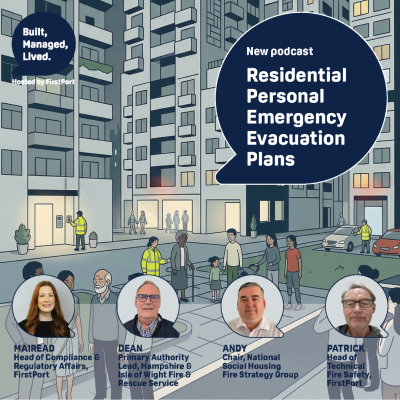
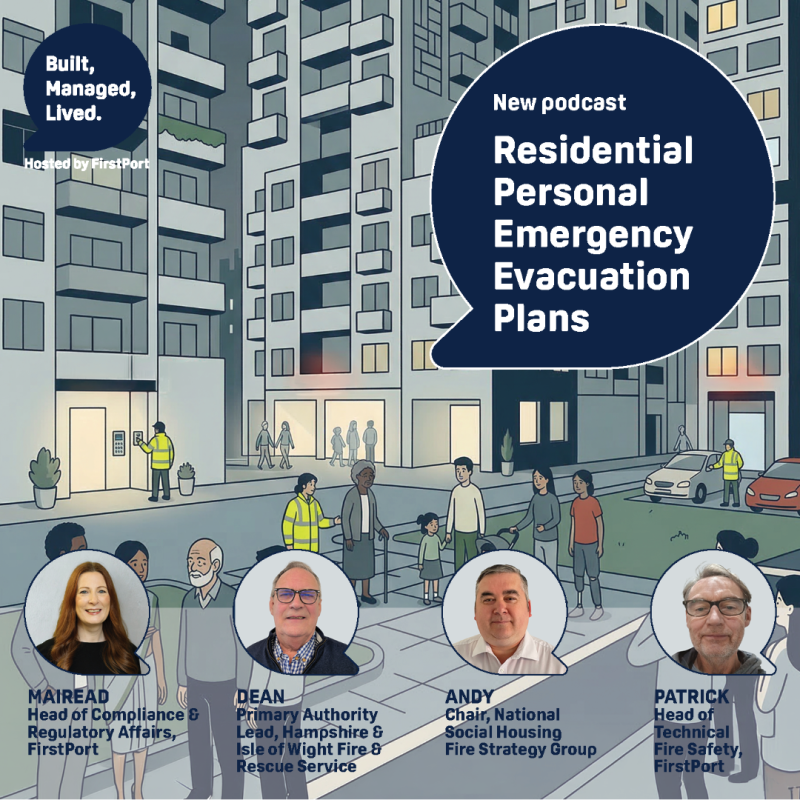
In this episode, we take a look at changes to Residential Personal Emergency Evacuation Plans (Residential PEEPs) and what they mean for residents. Featuring fire safety experts Patrick Heaney, Andy Frankum and Dean Dixon, the discussion covers the new evacuation planning requirements coming into force and why resident engagement is vital to supporting those who may need extra help in an emergency.
Key Takeaways
More information on new legislation around RPEEPs and the importance of resident engagement can be found in our insight article, Why residential emergency evacuation planning matters more than ever.

Head of Compliance and Regulatory Affairs, FirstPort
Mairead is Head of Compliance and Regulatory Affairs at FirstPort, where she provides strategic guidance on current and emerging legislation and regulatory frameworks.

Authority Lead, Hampshire & Isle of Wight Fire & Rescue Service
Dean is Primary Authority Lead at Hampshire & Isle of Wight Fire & Rescue Service, working closely with central government promoting the Primary Authority Scheme and was elected by the National Fire Chiefs Council as lead officer for the scheme.

Chair, National Social Housing Fire Strategy
Andy is Chair of the National Social Housing Fire Strategy group which represents over 160 member organisations across the social housing sector in England and Wales. Andy was named #4 global influencer in the 2021 Fire Safety Global Influencers list.

Head of Technical Fire Safety, FirstPort
As Head of Technical Fire Safety, Patrick provides strategic direction on fire safety legislation at FirstPort, ensuring compliance with current and emerging regulations, while supporting operational teams with specialist advice and collaborating with external partners to promote consistent interpretation of the complex, and constantly evolving, fire safety landscape across the residential industry.
Mairead: Welcome to Built Managed Lift. Today we’re going to be talking about fire safety and residential personal emergency evacuation plans. For our chat today, I am joined by Patrick Heaney, who is the Head of Technical Fire Safety here at Firstport, Andy Franken, Chair of the National Social Housing Fire Strategy Group and Dean Dixon, Primary Authority Lead for Hampshire and Isle of Wight Fire and Rescue Service. Welcome to you all. So, let’s start with what is a personal emergency evacuation plan. And Dean, when we had a little prep for this, you said I don’t like that title. So I’m going to come to you, what is it and why don’t you like the title Personal emergency evacuation plan?
Dean: Ok, well let’s start with why I don’t like the title. We’ve had peeps in the workplace for a fair few decades. We all understand what they mean. They mean that if somebody needs assistance to evacuate, there is a system in place to enable them to be assisted out of the building. So when this was first muted as being residential, it threw panic through responsible persons that manage buildings with residential persons because they thought they would then have to employ far more staff to be able to do personal evacuations for residents that required it. And that was never the case. So by calling it a peep, it threw that note of confusion into it which they made it a lot more difficult to deliver because now responsible persons are trying to overthink what is actually required and really what is required. It’s just a system that identifies where people living in flats who may not be able to self-evacuate for any particular reason, whether it be mobility, sensory impairment or anything else, it gives them an opportunity to say look, I need some assistance and then we can notify what that is. So the fire service are aware of the risks when they attend. There’s never really an expectation that responsible persons will provide the persons to be able to carry that out. And I think that’s where the confusion lies. So it is purely and simply about understanding what is need by a resident, how they can then identify what their needs are so when the fire service arrive they can provide that assistance to be able to evacuate.
Mairead: So what should we call them? Our peeps.
Dean: Well, they call them our peeps. I think we’re going to be stuck with the name.
Mairead: Ok. I will try and stick to our peeps for the purposes of our discussion today. Patrick, from a building safety and operational perspective, what should residents understand about our Peeps and why this process matters?
Patrick: It actually leads on from what Dean was saying. I think that we need to cut through the confusion and the concern that residents will have. And it’s essentially a conversation between the responsible person, what the legislation and regulations refer to as a relevant resident. So it’s their only or their principal residency. But it’s actually a conversation between the responsible person and the relevant resident in terms of what support they may need in order to be able to safely evacuate from the building. And it’s really important because I think the regulations have been many years in the making for lots of different assuaging any concerns that a resident may have and just working in partnership.
Mairead: Andy, I’m going to come to you next. Why is this such an important conversation in the housing sector, and why is it right that residents are much more central to this process?
Andy: We all know why we’re here with this legislation. It was a direct result of the Grenfell disaster and there were a number of residents in that block that perished because they had a disability and were unable to evacuate. So that’s really important, the housing sector because our primary duty is to protect our customers, our residents. And so we saw from that disaster and other disasters that have occurred previously that sometimes residents weren’t listened to. And so it’s really important that there’s two way dialogue with both the responsible person, the landlord, the property owner, the leaseholder and the resident or the customer. Because, you know, it really is about having that open conversation about how we can support the resident to make sure that in the event that there’s a fire in the building or in their property that there’s a mechanism and there’s a plan. And that’s why we’re here today to talk about what that means.
Mairead: Andy, why are we talking about this now? Is residential personal evacuation plan a new thing?
Andy: It is new in terms of that. There’s new secondary legislation that’s coming into force on April the 6th this year, which is the residential peeps regulations and that was a direct result of the Grenfell enquiry recommendations following the Grenfell disaster. Government have been consulting with general public on this for some time. Originally it was EEIS and some other forms and there’s been lots of consultation and as a result government have now set out what these regulations mean and we’re going to be talking through some of that today.
Mairead: Great. Patrick, if a resident’s listening to this and thinking what does this mean for me, What does it mean for them?
Patrick: It’s an important, it picks up a little bit on what Andy said and what Dean said and the fact that the regulations are the result of years of consultation and it’s the last three recommendations from the Grenfell inquiry that are now being implemented and just to come into force on April the 6th. And they’re only relevant for currently, they’re only relevant for England. But that’s not to say that Scotland and Wales would follow the same process as best practice, but legal basis is only relevant for those buildings in scope within England. What’s important about it is that because it’s been so long in the making, we need to remember that this is a completely resident led conversation whereby we are working in partnership to really, really ensure that their safety in the event of a firing, an unlikely event of them having to evacuate, that we’ve considered all of the reasonable scenarios when we’re having that conversation with residents. So from a point of view of a resident listening to this, it’s for the responsible person to make what the regulations call as reasonable endeavours. And I know we’ll be touching on that. But I think depending on the nature of the building, those reasonable endeavours can be anything from the use of FirstPort’s intranet. It may well be where we’ve got scheme managers on site. It may well be engaging directly with residents and the regulations allow residents to make contact with First Port as well. In fact that’s to be encouraged. But it could be anything from leaflet drops. I know from the Responsible Persons Toolkit, some of the exemplars, social housing providers, some of them have been doing door knock. So there are many different ways that the responsible person can make contact with a relevant resident. And I think the regulations are so new. As the regulations start to mature, those methods by which we contact a resident will change. But at the moment it’s for the responsible person should know their building better. So we’d be able to determine what is the most prudent way of informing the residents. So it could be a poster on the wall, it could notice board leaflet under the door, door knock. There are any number of methods by which we could contact residents, but I think it would depend in a lot of cases on the nature of the building.
Mairead: And Patrick, you said at the start of that that it applies to buildings in scope. So what buildings are in scope?
Patrick: So at the moment we’ve got buildings in scope are those buildings over 18 meters regardless of the evacuation strategy where there are two or more residential premises. But it also extends to buildings between 11 meters and 17.9 meters over five storeys where there is a simultaneous evacuation process in place. And that building scopes are the over 11 meters is a newer addition because typically I don’t know, Andy and Dean will know it better than me. Typically buildings in scope are being those buildings over 18 metres where have been the main focus. But this is bringing in 11 metres to 17.9 metres with a simultaneous evacuation process in place.
Mairead: Dean, you’re the principal lead in a Fire and Rescue authority. How do you feel about that extension of the scope to buildings that are over 11 metres?
Dean: The way any legislation is led, we always start off with worst case scenario. The worst-case scenario being built is every 18 meters. We know. Then we get the buildings in scope. That will be simultaneous evacuations, 11/7 point .9. We know that’s going to happen. We know that’s where we have to start the process. It wouldn’t surprise me if sometime in the future we extend to other residential premises in order to protect residents. Remember, this is about saving lives, it’s about protecting people. It’s about getting people out of a building safely so they’re not in peril and we don’t lose lives and we don’t have injuries. It’s all about that. So yes, we can look at worst case scenarios, big buildings, medium sized buildings. I think inevitably it will stretch into something further. I can’t say that the definitely my gut feeling is that’s the direction we will eventually move in.
Mairead: This is an incredibly important process for someone living in in one of those in scope buildings who may have difficulty evacuating in the event of an emergency. Is it a compulsory process?
Dean: Well, it isn’t, no, but because the focus is on life safety and the preservation of life and the prevention of injury, we would hope that all residents participate within scope. So if they have a need, if they have a, a requirement for assisted evacuation, that they will engage in the process because it’s only geared up towards their safety. It’s not for anything else. We’re not trying to gather information for nefarious purposes. It’s purely and simply because we want to look after those people who may be at risk. So this is a process that’s purely voluntary, but we would just hope that everybody will engage because with that information then we can make some real differences.
Mairead: Andy, from a housing provider point of view, what does a reasonable and proportionate approach to getting people to engage look like?
Andy: As Dean said, this is really about having a conversation with residents of customers, leaseholders etcetera and there are some organisations out there that have been doing person centred by risk assessments for some time and their processes will be well established. Other organisations are just at the start of that journey. So for me it’s about people sharing knowledge and information. At an organization level. We all want to achieve the same things, we want to protect our residents and that will be different. We’ll all have different buildings, we’ve all got different residents. Some of those may have some form of disability that might need some support. So it’s really how we do that. But it’s also about learning and listening with residents and sharing those good practice because there are many solutions out there. You know, it’s very much a person-centred process really to make sure that that residents are comfortable and happy, that they know what they need to do if there was a fire in their property, but also if there was a fire in the building. They understand what works for them. Resident is the best person that we can speak to because they live this day in and day out and they’re the experts in this. So it’s really just how can we facilitate that and agree on the best approach to keep them safe?
Mairead: But what if they don’t engage? Patrick, I’m going to come to you on this. Is it from the responsible person’s perspective? Is a case of 1 and done? You ask? Once no one responds, that’s the end of your duty. Or is the duty ongoing? Do these things have to be reviewed?
Patrick: It’s an interesting question. So the regulations require the responsible person to make what’s termed as reasonable endeavours and I think Dean’s made the point the legislation is so new, the determination of what reasonable endeavours actually means will come out in the fullness of time. But the guidance would suggest that it’s when somebody moves in or when you are first aware that they might need support and then what the guidance says is that they’re after annually. Now I think that our responsible persons interpret that will be different and proportionate to the nature of the buildings. I think as Andy’s mentioned, whilst the regulations are in place with it being entirely resident led, if the resident doesn’t want to participate and that’s technically the end of the process as far as legally required, a responsible person should make notes of that. If a resident doesn’t want to partake, then the resident can’t be enforced to partake. And typically as well, if a resident gets part way through the process and decides that they don’t want to take part anymore, then that’s the process stops there. So yes, it’s regulation, but with it being entirely resident led, there is no legal requirement for them to partake in the process if they don’t wish to.
Mairead: Dean from an enforcement point of view, what would you expect a responsible organization to be able to show in this process?
Dean: Interesting question again. Guidance is guidance. So the guidance around the provision of peeps suggested PCFRAS, person centred fire risk assessments, gleaning the information, building a process to be able to deal with what you need to deal with. As far as what the RP’s responsibility is, it’s being able to show what steps have been taken in order to get that information. And as was alluded earlier, it’s not just A1 case. You don’t knock on somebody’s door and say can we come in, No, ok, we’ll go away, then we’ll do it again. You have to be able to show a number of steps in a process that suggests multiple ways of gaining information. That could be anything. And we can’t say what it can be for every organization because your resourcing is different for every organization. So because of that, they can only be guidance and guidance points you in the right direction. You manipulate that guidance to work with your organization. So it might be if you’ve got a concierge, for example, who has personal connection with some of the residents in the building, that might be one way of gaining some information. They will know the people that may be amenability impaired. They will know the people that may have hearing difficulties, vision impairments, They will know some of that information. So maybe some of that information we got to start with so that you know which doors to and knock on so you know which doors to go to rather than do a, a whole blanket sweep of the entire building. But then letter drops, put letters through the doors, explain what the process is, explain why you need the information. Ask people to volunteer to come forward to give that information. You could put a questionnaire through the door and say, can you complete this questionnaire? It’s purely and simply confidential. You don’t have to tell anybody about it. Put it in a sealed envelope, give it back to the concierge so that we can gather that information. And it’s discreet, it’s quiet. Nobody needs to know just you and me. But from a fire service perspective, we would be looking, looking for something that says you have followed steps to be able to get the information and audit trail. Something that says you started from point A, you finished up at point D, or how many steps you’ve got and you follow that process throughout and that is consistent for every person within your building.
Mairead: Thanks. That’s a really helpful explanation. If there’s someone listening to this today and they’re thinking, well, I live in a building and it’s in scope and I think I might have difficulty evacuating, let’s see if we can set their minds at rest and we’ll talk through what information they need to provide. So, Dean, can I come back to you on that? What information do we look for from residents?
Dean: Well, we’re looking for fairly high level information. Say, for example, somebody has a hearing problem, OK, So we know they’ve got some sort of challenge within the way they process information. We don’t need to give it medical term. We don’t need them to say it’s auditory neuropathy or give it a nice turn. All you need to say is actually I can’t hear very well. So because I can’t hear very well, I might not be able to hear an alarm that’s going off. I might not hear somebody banging on the door, ringing my doorbell. That’s not something I’m capable of. So we know now they have a hearing issue. He’s somebody who because they’ve got osteoporosis, they’ve got crumbling of the spine, therefore they’re not quite as mobile as they should be. We don’t need to know that’s what the problem is. We just need to know they’re not quite as mobile as they should be. So it’s really top level information. It’s we don’t want any medical history, we don’t want any medical problems. We just need to understand what is required. They have mobility issues, therefore they need assistance to self evacuate from the building. That’s it. They’ve got hearing issues. They may not hear the fire alarm, they may not understand the risk. That’s what we need, cognitive issues. So again, you know, lots of people have mental issues because maybe alcohol abuse, maybe drug abuse. That’s very, very personal to the individual. But if it’s a cognitive issues where under certain circumstances they understand the risk and therefore may need assistance to get out, that’s what we need to know.
Mairead: So this is matching up the needs that a person may have with their location in the building exactly.
Dean: It’s exactly that. So we need to know person in flat 61 has mobility issues. All the information we need to have. We don’t need to know whether that person is a woman. It’s not gender specific. We don’t need to know their ethnicity because it’s not important. It doesn’t add anything to what we require. All we need to know is do they need assistance, what assistance that may be and where will we find them?
Mairead: So, Patrick? Dean’s just said that this is broader than just for people with physical disabilities. Can you expand on that a bit?
Patrick: It’s an interesting one. Because I think when everybody thinks about emergency evacuation plans that sort of correlate it to a physical disability, but actually it’s much, much broader than that. So I know Dean touched on it earlier. And depending on the nature of the disability, it could be a cognitive impairment, It could be any number of reasons why that individual can’t self-evacuate. It’s also valid for children as well. It’s not just about adults, it’s for all residents. So if the nature of someone’s impairment means that they can’t physically partake in the process because it’s resident led, if that resident can’t partake for whatever reason, the nature of their impairment means that they can’t. The regulations have what’s known as representative. So if it’s a child, the representative would clearly be parent, carer or somebody like that that can make those decisions on behalf of the child. But where the nature of the impairment means that that individual can’t partake, then a representative must be somebody with either power of attorney or some other legal controls over that individual because the individual doesn’t have to be part of the process. So that’s one extreme, hopefully quite rare, but you’ve also got the other side of it whereby a resident is physically able to take part in the process, but choosing not to for whatever reason. So the regulations are now for what’s known as a trusted person. So a trusted person can be part of the process, the RP process. The difference being is that the fact that the resident has chosen to partake in the process but not actively partake in the process, they have to be present at those conversations. Unlike where you’ve got a representative, the individual relevant resident doesn’t have to be part of that process. And I think that’s just important to call those two differences out, so.
Mairead: If someone’s listening to this and they’re feeling quite anxious about engaging in this process, they have the option of appointing A trusted person to help them complete forms, come along to meetings with the responsible person to discuss their needs. Dean, from a fire service perspective, why is it important to understand issues like hearing, sight or cognitive impairment as well as mobility?
Dean: Because every fire service when the intended incident will have a response plan and that response plan will vary depending on the type of premises and the type of occupation. If we arrive at a premises and there’s people that we know will need assistance to evacuate, it allows us to better resource the rescue and assist with the evacuation than we would otherwise have been able to do. Somebody who’s mobility impaired, for example, might need more assistance than somebody who needs to be led. simply because they can’t hear. You could bring them out the apartment, you could point them to the staircase and they could self-evacuate because they’re already aware of what’s going on. Somebody whose mobility impaired may need to be assisted down the stairs. And so it makes a difference if we know what the impairments areas to how we can resource or assist with the evacuation.
Mairead: So how does this process work. Once the resident has come forward, what’s the next practical steps in the process Patrick?
Patrick: The first step. Would be once you’ve identified the relevant resident and they’ve agreed to participate in the process, you then carry out what’s called a person scented fire risk assessment. And it’s been in play for a long time, which is an assessment of the risks actually within the that. And may well be that they need some additional support with the hearing devices and things like that. But then also what the process is around how that individual can be supported to evacuate and what that then generates you what’s called the emergency evacuation statement, which is a very simple statement around what support they will need. What falls out of that is then the information for the Fire and Rescue service, which is basically to Dean’s point where they are brief nature of why they need support to evacuate, whether they have an emergency evacuation statement and that goes into the secure information box which is on the outside of the premises. All can be shared electronically and Fire and Rescue services in England, some require it to be shared digitally. Some London Fire Brigade, for example, have suggested that it won’t accept digital, so you’ll have to put it as a hard copy insecure information box, which is outside all of the buildings in scope. So that’s the process,
Mairead: Andy. How does this work from a wider housing sector perspective?
Andy: First and foremost things about the strategy of the policy that your organization has. So we know across the wider sector there are organisations proactively embedding the regulations, but absolutely going over and above exceeding those because that’s what we should be doing, right? We should be protecting all residents that need it. And so when you’re looking at the approach, there are a number of phases that you need to think about. So one is about your data. You may already have existing information about residents. So it’s important that one to check that that’s accurate, but also to go through a process where you obtain consent with those residents over a period of time. And so that starts with that conversation that we’ve been talking about with residents. For me, first and foremost, there’s it’s one question, can that person self-evacuate in the event of a fire? There’s lots of other follow up questions that may come from that. You know, we’ve talked about cognitive and mobility impairments, but we’re not here to capture all of that information. We want to understand are you able to get out in the event of a fire and if you can’t, that then kick starts the person-centred fire risk assessment process and that’s the start of the conversation with the resident. Obviously making sure that the resident consents to that and consent is a big part of the process at every stage. It’s about reaffirming and making sure that the resident is comfortable and is happy to proceed with that. And once you’ve been carried out that person centred fire risk assessment with the resident, that then leads the developments of the emergency evacuation statement that Patrick mentioned. And that’s a green on the steps that can be taken. Now some of those steps might be straightforward. It’s partly about reassuring the resident as well because when we talk about the risk of fire, you know, that is low generally, but obviously if it did happen, there’s a high impact, certainly in high rise buildings. So it’s important that we take practicable steps to ensure that the right type of solution and process is available and agreed with the resident. That information must be documented. As Dean mentioned, there needs to be an audit trail, but it’s more than just having an audit trail. It’s about making sure that we’re going through that process to ensure that we’re taking the right steps, we’re protecting the resident and the resident feels assured that they’re safe in their home. But also then about obtaining consent to share that information or some of that information with the Fire and Rescue service. And that doesn’t need to be everything that we’ve talked about. That can simply be the location and a colour coded system that sort of sets out what type of assistance may be required. And again, that information will need to be placed in the secure information box on the building and each farm rescue service will have a different approach to that. So it’s important that you make contact with your local farm rescue service, understand what their processes for recording that information, but also updating what’s called a beep or a building emergency evacuation plan. And in both situations, they will need to be reviewed regularly if anything changes at the very least every 12 months.
Mairead: Dean coming. Back to you. Why is this information so important to the fire service?
Dean: Well, it depends. Again, on resourcing, each fire service when the attended incident will have a response plan. They’ll know what they need to do depending on the type and size of the building. But working in a fire environment, it involves a lot of dynamic risk assessments. So we have to reassess the situation as the situation develops. So if it was a single fire, for example, at a flat 61, then that’s where we’re going to focus our attention initially because we need to control that fire and stop it from escalating. But because it’s a dynamic risk assessment, we have to assume that if it starts to get out of control, that it might move to other parts of the building. So as a precaution, we may evacuate the entire floor to make sure that those residents don’t become at risk from the smoke that starts to come from the compartment and starts to fill out the evacuation routes. So we’ll do a targeted evacuation for various parts of the building. Now, if we know there are people that have mobility impaired or have impairments that need assistance, we can use some of our resources to evacuate those from different floors. If we think we need to escalate further, some fire services, for example, evacuate the floor of origin and maybe one or two floors above, well, if they know that there’s people in there that are mobility impaired, they can pull those people out early. And because they move those people out early, everybody else can safely evacuate. We know that we’re not increasing the risk to an individual and it all comes down to what we know, the information we’re given at the first instance. So when we go to the secure information box and we pull the box out and it’s got a list of flat numbers that have people in there that need assistance and it identifies what that assistance is. It does enable us to resource it to be able to evacuate people in a timely fashion so there isn’t a mad rush if things start to go wrong and hopefully, they never do
Mairead: And does it influence how many people you send to? indeed.
Dean: Indeed. it will, depending on what the requirement is. If somebody is visually impaired, for example, you may be able to get them to a staircase and they may be able to come down their staircase on their own. If they’re hearing impaired, you just need to make aware of the fact there’s a risk. Put them into a staircase and they will self-evacuate. If the mobility impaired, they may need assistance that may require the use of equipment that gets them down the stairs. It may require the assistance of more than one firefighter to be able to assist with that person getting out of the building. So it really depends on the level of assistance they require as to how many people resource to each of the individuals
Mairead: And will the information that’s provided in the way it’s used look the same for every Fire and Rescue service?
Dean: The information that’s provided obviously is down to the responsible person. So we ask for the information upfront. We ask for that information to be put forward. As I said earlier on, the information is fairly high level. We just need to know what’s required, what is the impingement, what do we need to do? Where can we find the person that requires the assistance? That’s the information that they need. That will be in the secure information box. 99.9% of the cases fire service will require that in the secure information box. Some may also require the information to be provided electronically. Now, many services are setting up sites on their own web pages within the fire service where you can upload information so they have it additionally as electronic. Some fire service require both methods. Others are quite satisfied with a single method. But if we said that everybody puts that information into a secure information box, that’s a really good starting point.
Mairead: Andy does that create some operational challenges for landlords and housing providers across the country?
Andy: Yeah. Absolutely it does. Larger organisations that have got huge portfolios will be operating across multiple counties and boundaries, so some will have properties in Scotland, England and Wales and that can present a challenge from a devolved administration point of view. So the key here is that’s where primary authority can play its part and the key will be having it considered and robust process that the organization follows. And that’s why I said before it’s important that organisations share good practice, they come together because this is new regulation. You know, some organisations have been this for a while, some just start that journey. Whatever we do, we must come together and share that good practice and that will enable us to make sure our residents and customers are safer.
Mairead: Patrick. You’re agreeing forcefully with Andy there.
Patrick: Nodding forcefully yeah I think it’s really important because the regulations are brand new and as we’ve said before, as they mature, the information to Andy’s point around what is best practice, the Responsible persons toolkit, which already exists as a number of exemplars and I think that will be built on this. The process becomes more embedded and better understood. I think from a perspective of an organization that has buildings in scope within multiple Fire Rescue service, fire authority areas in England. The regulations will state something like you got to make reasonable endeavours and gives you a bit of guidance. The benefit of having a primary authority is that an organization can set what it considers it’s reasonable endeavours. Present that to the primary authority and there’ll be a two way conversation. They might disagree or they might make some suggestions, but if that gets approved, then that becomes under the terms of primary authority agreement, what’s known as assured advice, which is if a Fire and Rescue authority inspect a building and potentially possibly not happy with the reasonable endeavours process, we can refer it back to the fact that it’s had primary authority approval. But I think Andy’s point is really well made in terms of we will all learn from, this isn’t brand new for everybody. And I know Dean made the point. It’s guidance at the moment and it needs fleshing out. And I think that we can all share best practice because no one’s in competition here. This is about resident safety. So if an organization within Andy’s network has got some ideas of best practice, then we would be stupid not to look at that and take those on board, and vice versa.
Mairead: I think this has been a really interesting chat and we’ve got some information there that is very much from the resident perspective, what a resident can expect to hear from their landlord, what a resident can do of their own volition, and what the outcome for the resident should be. You’ve made some really helpful points to assist responsible persons in putting together their plan for putting residential peeps in place and deem from a fire surface perspective. It’s so interesting to hear how you use that information to plan dynamically in really difficult circumstances. So just to round off, what would you like people to take away from this? Patrick, I’ll come to you first. What’s the main thing you want a resident to take away from our discussion?
Patrick: It’s been touched. On very many times and it’s right that it has the whole idea around this is the responsible person working partnership with a resident once been identified to really reassure that resident. It’s a conversation that’s designed to ensure their safety. It’s resident led, it’s consent based. And you would hope that the nature of the conversation would ensure that the resident understands that it is consent based and in a two way conversation because ultimately it’s about ensuring the safety and event of a fire of all our residents. And that’s what I would ask that we take away from this.
Mairead: Thanks, Patrick. Andy, can you take that same question, but from the housing sector perspective, what would you want a landlord or a responsible person to take away from this conversation?
Andy: There’s a clear message there to the housing sector to really put residents in the middle of the process. It’s about learning and understanding how we can support residents to be safe. And the reality is that fire doesn’t discriminate. You know, whether you’re a leaseholder or a customer or a resident, whatever term we use, it’s about making sure that everyone can get to place of safety when there’s a fire. And that’s what this is really about. It’s about the spirit of the regulation and know there are organisations out there applying this process to lower risk buildings because it’s about the person, it’s about the individual. It’s about making sure that planning this on a risk-based approach to make sure that you’re putting your resources in the right places and to protect residents from that. And the other view that I would have is that for those residents or customers that don’t want to engage in this process, because there will be some, all I would say is let’s have a conversation. We’re listening and we do want to make sure you’re safe from fire. And we will assure you what we can do to make that happen but also try and give you information that helps you to engage in that process.
Mairead: Thank you. And Dean, from a fire service perspective, what should we take away from this?
Dean: Going back to my very early point where we started the initial conversation, The fire service is only here to save lives. All we want to do is to make sure that people are safe by providing the information that we’re asking for. For organizations such as yourself to be able to put the information into forms and run processes so that information is available to us enables us to make that job a lot simpler. It means that when we attend a fire, when we intend an incident, it’s not just to put the fire out, it’s there to save lives. With the information we can achieve that.
Mairead: Brilliant. Thank you all so much for coming today.
Dean: Way to end.
Mairead: It is a way to end.
Mairead: Thank you. Really appreciate your time. Thanks again.
Be part of the conversation
Have a perspective on how homes are designed, managed or lived in? We’re always looking for new voices to join the conversation.
Explore our latest conversations about residential property management
Never miss an episode
Join us on Spotify and Apple Podcasts for fresh conversations, stories, and insights.
Get in touch to learn how our range of residential property management services can support your development.