Britain has a later living problem. But it isn’t the one most people think.
The challenge isn’t simply that we’re building too few retirement communities. Nor is it that older people are unwilling to move. The real issue is that our understanding of later living has failed to keep pace with the way the sector has evolved.
For too long, later living has been framed as specialist housing for people whose independence is beginning to diminish. It remains closely associated with care homes, dependency and the final stage of life. Yet that picture no longer reflects the reality of the modern sector.
Today’s later living communities are increasingly designed around something entirely different: extending independence, reducing isolation and creating environments where people can continue to live active, fulfilling lives for longer.
That distinction matters.
Because later living is no longer simply another residential asset class. It sits at the intersection of some of the biggest structural challenges facing the UK today: an ageing population, constrained housing supply, rising pressure on health and social care, and growing concerns around loneliness and wellbeing.
The question is no longer whether the sector deserves greater attention.
It’s whether policymakers, investors, developers and the wider housing industry are prepared to recognise the role it is already playing.
We’ve misunderstood what later living actually is
Perhaps no sector within residential property suffers from a greater perception gap than later living.
Ask someone outside the industry what comes to mind, and many will immediately picture residential care. That misunderstanding shapes conversations long before anyone steps inside a development.
In reality, later living is not about relinquishing independence. Quite the opposite.
Residents continue to own or rent their own homes. They maintain complete control over how they live. They choose whether to take part in community activities, when to socialise and how much support they require. The difference is that the burdens associated with maintaining a home become significantly lighter, while opportunities to remain connected become considerably greater.
That may sound like a subtle distinction, but it fundamentally changes the proposition. The sector isn’t providing care.
It is creating the conditions that allow people to remain independent for longer.
The irony is that the industry’s biggest challenge may not be developing new communities at all. It may simply be helping the public understand what modern later living has already become.
Housing policy has focused on the bottom of the ladder while overlooking the top
Much of the UK’s housing debate centres on first-time buyers, affordability, planning reform and housing delivery.
These are, of course, hugely important issues.
Yet relatively little attention is given to the opposite end of the housing market.
Across Britain, millions of family homes are occupied by people whose children left years sometimes decades ago. Many of those homeowners have little desire to maintain large properties, extensive gardens or ageing buildings. Equally, many have no interest in moving into accommodation they perceive as limiting their independence.
The result is inertia.
People remain in homes that no longer suit their needs because the alternatives fail to excite them.
Countries including Australia, New Zealand and the United States have approached this challenge differently. There, later living has increasingly been positioned as a lifestyle choice rather than a care solution. Communities are designed around convenience, wellbeing, social connection and quality of life.
In the UK, we continue to frame later living through the language of ageing.
That matters because aspiration changes behaviour.
If people see later living as something they choose, they are far more likely to move while they remain active, healthy and independent. That, in turn, releases larger family homes back into the market, improves housing mobility and creates movement across the entire housing chain. Seen through that lens, later living stops being a niche product.
It becomes an essential component of national housing strategy.
Independence is becoming one of the sector’s greatest contributions
Perhaps the most significant shift in recent years has been the growing recognition that housing itself can influence health outcomes.
The traditional distinction between housing and healthcare is becoming increasingly blurred. Well-designed later living communities don’t simply provide somewhere to live. They provide environments that encourage people to remain active, socially connected and engaged with the communities around them.
That has profound implications.
Loneliness is now widely recognised as one of the biggest challenges facing older people. Research consistently links prolonged social isolation with poorer physical and mental health outcomes, increased demand on health services and reduced overall wellbeing.
Later living addresses that challenge in a remarkably simple way. Community is not treated as an optional extra. It is built into everyday life.
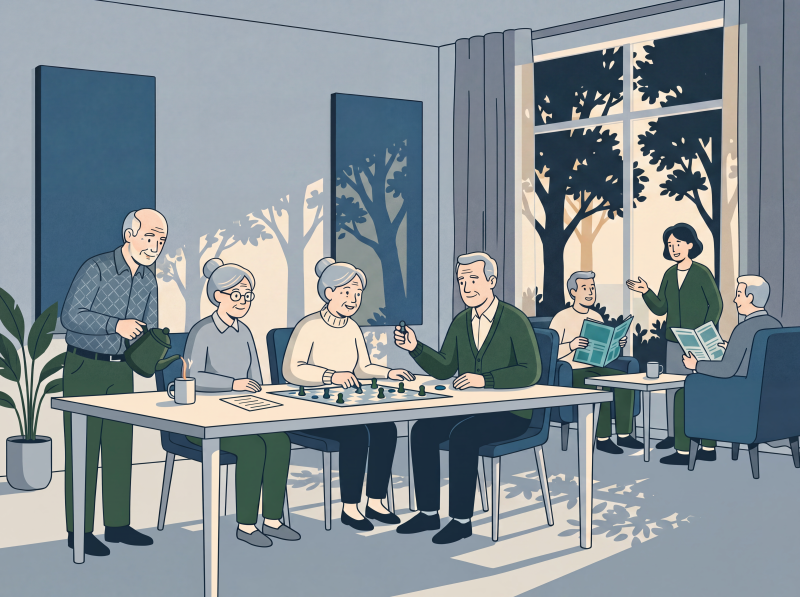
Shared lounges, communal gardens, organised activities and on-site teams create opportunities for residents to meet naturally, rather than relying on external interventions to combat isolation after it has already taken hold.
Crucially, participation remains entirely voluntary.
The most successful later living communities don’t force interaction. They simply make it easier. That distinction is often overlooked, yet it represents one of the sector’s greatest strengths.
The industry’s competitive advantage isn’t the building
For decades, residential property has been judged by a familiar formula: location, specification and amenities. Better finishes, larger communal spaces and a longer list of facilities were seen as the hallmarks of a successful development.
Later living is quietly changing that equation.
The communities that consistently succeed are not necessarily those with the largest restaurants, the most luxurious wellness facilities or the highest specification apartments. They are the communities where residents feel connected. Where neighbours know one another. Where communal spaces are genuinely used rather than simply admired. Where the building supports relationships instead of simply accommodating them.
That represents a profound shift in how value is created.
The physical asset remains important, but increasingly it is only the starting point. The experience of living within that community has become the true differentiator. This is where the role of the managing agent is evolving faster than many outside the sector appreciate.
Property management has traditionally been measured by operational excellence. Keeping buildings compliant, maintaining communal areas, controlling expenditure and protecting long-term asset value remain fundamental responsibilities. Yet the best operators are now expected to deliver something considerably broader. They are expected to foster communities where people remain active, engaged and independent for longer.
In other words, they are no longer simply managing buildings. They are managing places.
That evolution mirrors changes already seen elsewhere in operational real estate. Build-to-Rent operators increasingly compete on resident experience rather than apartment layouts. Student accommodation providers have learned that community is every bit as valuable as the quality of the bedrooms themselves. Hotels long ago realised that service defines a stay as much as the building.
Later living is following the same trajectory.
The communities that thrive over the next decade will be those that recognise their greatest asset isn’t the building itself. It’s the life that happens within it.
Confidence, not demand, remains the sector’s greatest challenge
The sector often talks about supply. Government talks about planning. Investors talk about development pipelines.
Yet the bigger challenge may simply be confidence.
Buying a later living property is unlike almost any other housing decision. For many residents, it represents the final move they expect to make. Unsurprisingly, that creates a level of scrutiny rarely seen elsewhere in the housing market. Families ask difficult questions about service charges, resale values and future affordability. Prospective residents wonder whether they’re moving too early or leaving behind a home that has defined decades of their lives.
These are not irrational concerns. They are entirely understandable.
The industry’s response, however, has often been to answer each question individually rather than addressing the bigger issue.
People are not simply buying an apartment. They are buying confidence in the next stage of their lives.
Confidence that they will remain independent. Confidence that support will be available if circumstances change. Confidence that they are joining a community rather than simply relocating to another address. Confidence, ultimately, that they are moving towards something better rather than away from something familiar.
That is a far more powerful proposition than square footage or specifications alone.
A sector that has outgrown its reputation
Perhaps the greatest irony is that the later living sector has spent years evolving while public perception has remained largely static.
Operators have become more sophisticated. Communities have become more vibrant. Financial models are becoming more flexible, with rental options, deferred fee structures and shared ownership broadening the market. Technology is enabling residents to remain independent for longer while making buildings more efficient to operate. Even the debate around ownership models, including commonhold, reflects a sector thinking seriously about how it should evolve over the coming decades.
Yet much of the public conversation still treats later living as though it exists purely to respond to declining health.
It doesn’t.
Increasingly, it exists to help prevent that decline in the first place.
That distinction should fundamentally change how the sector is viewed not simply by prospective residents, but by planners, policymakers, developers and investors. Housing that helps people remain healthier, socially connected and independent for longer is doing far more than providing accommodation. It is reducing pressure on public services, improving quality of life and creating movement throughout the wider housing market.
Few parts of the residential sector can claim to deliver such broad social and economic value.
Changing the conversation
The UK’s ageing population is often presented as one of the country’s greatest future challenges.
Perhaps it should also be viewed as one of its greatest opportunities.
Longer lives demand different housing choices, not simply more housing. They require communities designed around wellbeing rather than dependency, independence rather than intervention and connection rather than isolation.
Later living has quietly been moving in that direction for years.
The question is whether the conversation surrounding the sector is prepared to catch up.
Because the future of later living will not be defined solely by the number of homes delivered or developments completed. It will be defined by whether the sector succeeds in changing one of the oldest assumptions in British housing: that moving later in life represents the beginning of an ending.
In reality, for a growing number of people, it may prove to be the beginning of an entirely different—and better—way of living.
Listen to the Built, Managed, Lived. podcast
Hosted by FirstPort, the Built, Managed, Lived. podcast brings together residents, policymakers, developers, engineers, and industry experts to explore how homes are designed, run and experienced in real life.