28 min 10 sec
Episode 8: Inside the evolving world of later living
Exploring the benefits, challenges and future of independent later living communities.
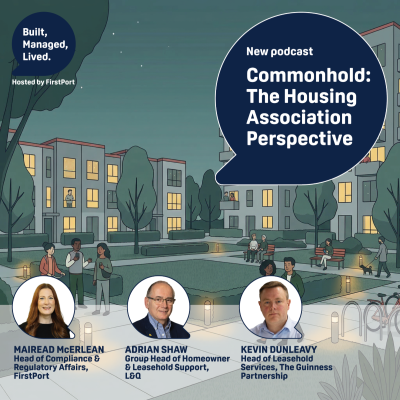
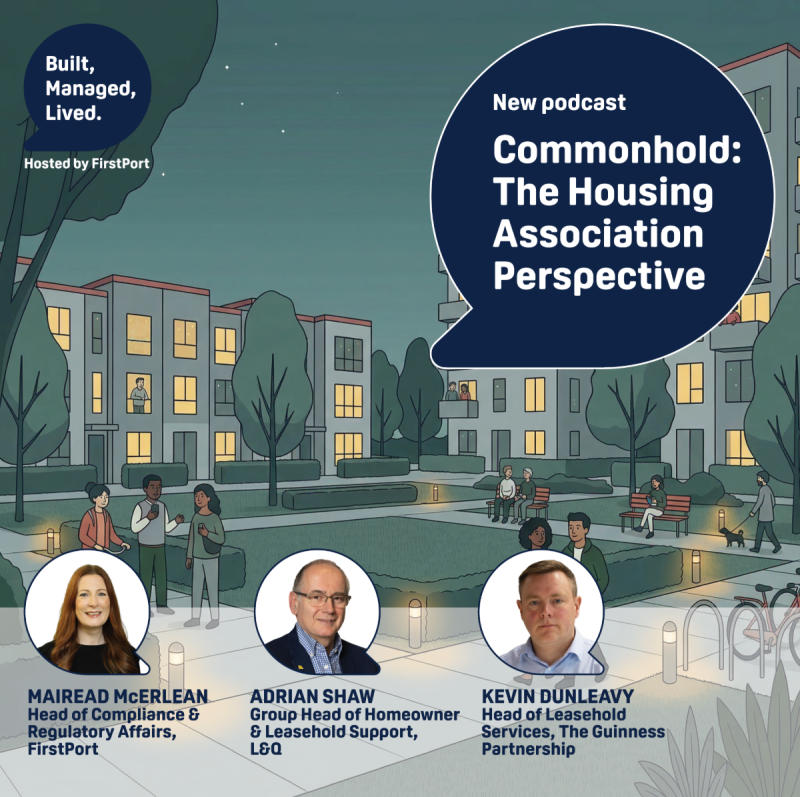
FirstPort’s Head of Compliance and Regulatory Affairs, Mairead McErlean is joined by Adrian Shaw of L&Q and Kevin Dunleavy of The Guinness Partnership to explore how the introduction of commonhold could reshape the management of social housing.
Key Takeaways
Read Mairead’s thoughts on the implications of commonhold for the delivery and provision of social housing: Commonhold and Housing Associations: Why structural reform requires long term thinking

Head of Compliance and Regulatory Affairs, FirstPort
Mairead is Head of Compliance and Regulatory Affairs at FirstPort, where she provides strategic guidance on current and emerging legislation and regulatory frameworks.

Group Head of Homeowner and Leasehold Support, L&Q
Adrian is Group Head of Homeowner and Leasehold Support at L&Q, with over 40 years’ experience in social housing across local authorities and housing associations in London, including more than 25 years specialising in leasehold management. A Fellow of The Property Institute and Board member of the National Leasehold Group, he has worked closely with MHCLG, NHF and TPI on shaping responses to leasehold reform and commonhold proposals.

Chair of the National Leasehold Group
With over two decades of specialist experience in leasehold management, Kevin has supported a diverse portfolio of leaseholders across shared ownership, right‑to‑buy, and open‑market homes. He is a founding member and current Chair of the National Leasehold Group, which supports over 200 members responsible for services to thousands of housing association leaseholders.
Mairead: Welcome back to Built, Managed, Lived. This is the second in our series of looking at Commonhold. And today we’re going to be looking at it from the perspective of housing associations. And I am joined by two titans of the social housing sector. I’ve got Kevin Dunlevy from the Guinness Partnership and Adrian Shaw from L&Q between you; you’ve got more than half a century of experience in the social housing sector.
Mairead: Do you want to say a few words about your careers and how you’ve ended up sitting on this sofa?
Kevin: You should go first. I should go first in the elder. I mean, reflecting on where I am now, I’ve done over 40 years in the housing sector, social housing, both in local authorities and housing associations. You know, for the last few years, very much working in the larger housing associations in London and now with London and Quadrant Housing Trust and the issues that are coming up now with changes in legislation is almost like the first time in my career that we’ve had major change in over that 40 years.
Kevin: So, it is a really big impact on organisations.
Mairead: So, when we talk about it being a once in a generation.
Kevin: It’s once in my generation, I think is fair to say we had the land on tent 1985. You know, I was at the early stages of my career, and it didn’t really come to impact me until much later in my career, when a suddenly started deeming the leasehold management.
Mairead: And Kevin.
Adrian: Yes, I bring over 20 years’ experience. I think the real difference now to when I joined the sector and for most of my time in the sector, is that we were very familiar, I guess, comfortable with the regulatory regime that we had to operate within, how to manage properties, how to comply with the relevant acts and, and so on.
Adrian: But I think now we’re looking at a degree of change in a pace of change that is unprecedented. So if you think back to the 1925 Law and Property Act, you’ve probably got between 8 and 10 key acts of Parliament between then and now that have shaped how we manage blocks of flats and leasehold homes, how we deal with service charges, how we regulate leases, etc. and the legislation, whether it’s from the Building Safety Act of 2022, the least 100 format to 24, and the regulations that of that that are still to come forward, but definitely most importantly, the Common Hold and Leasehold Reform Act, which could yet come through, that could see more of
Adrian: A disruption and potentially in a positive sense, than what we’ve seen in the previous 100 years within a very concentrated period of time. So, working in the housing sector now feels like you have to be very comfortable with adapting to a lot of change at pace.
Mairead: Adrian, can I come back to you? There’s a huge political momentum behind change, and from a housing associations perspective, what are you most focused on right now?
Kevin: I think, as Kevin touched upon, it is the compression of the last two years from 2024 onwards, possibly starting just pre-pandemic with the Law Commission’s review. And since then, and I think in particularly in the last few years, with the increasing in costs because of the pandemic and other economic factors. For me, it’s been very much the highlight the spotlight on service charges, the affordability of those, the costs of those and the amounts that that is now in the press.
Kevin: So it is that post bag that’s full of people’s concerns about what they’re paying for and how much they’re paying. So, we have the Leasehold and Freehold Reform Act. We are in the process of looking at the regulations and what are those are going to be. And then on the coattails of that, as Kevin just said, we’ve got the Commonhold and leasehold reform bill and all the proposals that are coming out of that.
Kevin: So, there’s a huge amount of content that in the next 3 to 4 years will have that major impact on housing associations and housing practitioners.
Mairead: And we see a lot of narrative in the press and from Parliament. That suggests that Commonhold is the silver bullet that will cure all issues that have existed with leasehold. Do you think there’s a gap between that political narrative, Kevin, and the practical reality of delivering homes in large blocks?
Adrian: Understandably so. I think parliamentarian parliament parliamentarians will view the leasehold landscape through the lens of their mailbox, and it’s undeniable that there will be flooded with complaints from leaseholders who’ve potentially received a bad service. But even if they haven’t, they may still be perceiving there to be something wrong, principally just through to the sheer increasing costs that we now incur in operating and maintaining increasingly complex buildings.
Adrian: And I think one of the things we need to get better at is informing both our residents and parliamentarians what’s behind that complexity, what’s driving that. And that’s like speaking into the void and not allowing just rhetoric and anecdote to inform. But we need to be providing more data, more information so they understand what’s driving it, that it’s not just random chance or a particular managing agent perhaps making a certain decision.
Adrian: It’s actually more fundamental than that. But yeah, I think the risk for parliamentarians is that they’re looking at radically changing the legal system for which we develop and convey property rights in blocks of flats, and for understandable reasons. But I think even to this day, when you talk about Commonhold, you’re often thinking of relatively simple blocks of flats.
Adrian: Maybe a house has been converted into a few flats, or a purpose-built block with a dozen or so flats and get common home. Makes absolute sense there. And I’m not saying common hold cannot work in more complex structures, because clearly it has been applied in other jurisdictions. But it’s going to be a lot more challenges to it.
Adrian: And I think the draft legislation we’ve seen so far, it makes some attempts to acknowledge that through the inclusion of the concept of sections and so on. But it’s very untried, very untested. And I think when we think about a lot of the developments that we have been developing and that we’re now managing and involved in, when we try and model what we’ve seen in the draft bill onto those, that seems to be more challenges there that have yet to be resolved.
Adrian: So, it’s definitely more complicated than perhaps people appreciate just yet.
Kevin: Can I just come back on the issue? You’re talking about the Commonhold and the way it’s been sold, because the term fleece hold is being used so much, and there’s a belief, wrong belief amongst homeowners that common whole will abolish costs. Will Boris charges and I no longer have service charges, but clearly, they will have charges to maintain the buildings.
Kevin: And I think, yes, there are certain bad landlords out there, but there will be certain bad common hold associations moving forward. And I think this is the problem, that there’s a mistaken belief that suddenly the charges will go away and that will be it, for Commonhold will be the panacea for everything.
Mairead: Let’s just talk about the way that housing associations will integrate into the Commonhold structure and how that differs from under the current leasehold structure. And so, in Commonhold, the Commonhold association will own the freehold of the common areas. Each unit will be a freehold unit. And for most residents that is going to mean that they will have a share in the Commonhold association, and they will have a vote that’s associated with that share.
Mairead: How is it different for housing associations?
Adrian: I think if we if we look at the government’s new homes target and the role that housing associations are expected to play in that 60% of the homes that are expected to be delivered by our sector under the current funding cycle are expected to be for social rents, and our social rent tenants will not be active participants in Commonhold associations.
Adrian: So, they’re going to be entirely reliant on the housing association. And I think the key difference. So, for your listeners, for your viewers, under the current system, there’s two the two most common ways housing associations deliver new homes, either through our own design and build contracts. We build a block of flats where the landlord, we manage it and ultimately the buck stops with us or through section 106 agreements.
Adrian: And that’s often where we will encounter managing agents, where we effectively, by the principle leasehold interest of the flats, we will under lease them or sublet them to our affordable housing tenures, and then we may flow down some of the service charges of all of the service charges. But we’ve got the principal relationship with the landlord, but that makes up the minority of our stock with commonhold.
Adrian: That would become the default. So immediately, if we’re looking at mixed tenure, housing associations would have to become quite used to the concept that they would be building blocks of flats, and at some point they would be handing over control of those blocks of flats to the Commonhold Association. And that’s an organisation that their tenants in our building are effectively disenfranchised from.
Adrian: So that’s that requires a completely different way of thinking and a different approach. So, the decision therefore for housing associations will be to what extent and how will we be engaging with those common hold associations. And some of that’s going to be determined by the regulator of social housing and the standards it publishes and expects us to comply with.
Adrian: And some of it will come down to our own policies that will develop, which we based on the desired outcomes we want to achieve assessment of risk, because there could be quite a lot of risk that we’re not used to, and also the challenges that places upon our operating models and our structures, because it’s going to require a very different way of operating and thinking, because you’re no longer just going to be a landlord.
Adrian: You’re going to start thinking as a company director.
Mairead: Adrian, do you think the government’s thought about how different that model is and how housing associations are going to have to change to accommodate that?
Kevin: I very much hope that they’re listening to what’s being said to them and what responses we’ve all made within the consultation, because clearly mixed tenure, which we develop has its complexities known as Kevin, as mentioned, the fact that we may well then have to put in additional governance arrangements to deal with Commonhold. We’ve had mixed tenure blocks.
Kevin: We will probably have to change that, that model to go to single tenure, to actually enable us to have the control where we need to have the control, and we shared owners. It’s going to be very complex because you’re going to have a shared responsibility under a common hold association. So, I think, you know, most housing associations, the G15 and the National Housing Federation have made that very clear to government of the concerns that we have about how common hold will develop and how it will go forward, and how we can ensure that our residents have as much say as possible, which we’re all supportive of, but that the common hold model might need some
Kevin: Tweaking for the ability for housing association to continue to develop affordable housing in the model it currently has.
Mairead: So, under the current model, you as a housing association may have a full block and some of that block will be shared ownership units. And some of that block will be affordable rented.
Mairead: If you move that into a Commonhold structure, initially it would be a freehold building for the housing association. But as soon as any of these shared owners’ staircase up to owning 100% of that unit, that entire block then becomes common hot.
Kevin: That is what the proposal is. And I think it’s that tipping point. And we’ve discussed that as well with, for example, right to buy in a building which we still have. We’ve got a number of stock transfer associations where people can exercise the right to buy. What point do you then say suddenly it’s now a Commonhold building as opposed to being leasehold building.
Kevin: Our concerns would be, you know, just one going to 100% ownership would bring an enormous amount of regulation and governance upon the housing associations, which would be complex, would raise costs and would be of concern. So, I think there has to be a look at a threshold to make sure that when you get to a particular point, whether it’s 50% or whatever, then that that’s when you might move to a Commonhold.
Kevin: But if you’ve got a balance in a block of, say, 50, 50, 50% share donors, 50% housing association tenants, yeah, the shadows are going to be very keen to have more say than involvement, but that will then bring it the complexity of governance which will cause us, I think, a degree of, of issue and potential rising in costs.
Mairead: Will it put an end to mix tenure in housing association blocks?
Adrian: Well, this is what we need to understand. We’ve with the responses we’ve submitted to government so far. And when we’ve spoken to the select committee, we’ve tried to make them aware that there’s a lot of potential secondary consequences to what they’re proposing. And housing associations are going to have to assess the risk. How comfortable are we going to feel housing our affordable rent and social rent tenants in buildings where the management of the building would eventually be taken over by private flat owners?
Adrian: And if you think about Adrian mentioned that the kind of governance structures, we’d have to put in place to try and safeguard that effectively, we’d have to treat every Commonhold association as if it’s a subsidiary of our organization. That could create quite a significant amount of governance pressure and risk. So, I think you could see a variety of policy positions across the housing sector.
Adrian: At the moment. I don’t think there’s one uniform position, although there is concern, but I think the possibility that some or quite a few housing associations decide we can’t tolerate this risk. We now need to start thinking about diverting from deliberately developing mixed tenure communities. That’s a real possibility, and that’s a fundamental shift for the housing sector. So, the whole idea of mixed communities has been at the core of housing policy ever since I’ve been involved in it, and probably even going back as many years as you’ve been involved with Adrian.
Adrian: But it is actually putting that kind of pressure. I think there’s a lot of people now looking at this, and the message I would give to anyone in the sector at the moment who’s still not sure of how to how to think about common hold while it undoubtedly delivers benefits and we need to make that clear, we do recognize the benefits of Commonhold and the reasons why it’s been called for.
Adrian: You need to think about things in terms of your approach to management companies, your approach to director roles as corporate directors of management companies, and how you would then deal with that within the governance structure of your own organization and to what degree you’re comfortable with that.
Mairead: So that’s talking about your governance frameworks. Let’s talk about long term stewardship of buildings. Housing associations would traditionally plan quite a long way in advance. How does that change under common hold.
Adrian: Changes it completely. So, we develop buildings and blocks of flats and houses with the intention that we’re going to be in that relationship for the long haul. We’re not looking to make a quick buck and to sell it and move on. We’re looking to stick around. So, if we’re granting a lease, it would have been for 125 years.
Adrian: Now. It’s often for 990 years. We’re expecting to be around for the duration and maybe not individually, but the organisations in concept could be. And that means thinking about long term maintenance plans. That means projecting affordability mapping. That means thinking about cyclical maintenance, but also business planning as well. So, we need to know how much we need to be allocating each year towards maintenance programs.
Adrian: And that can often be programmed five years in advance, maybe ten years in advance. Well, we no longer know if we’re going to be spending that money on that building, because we no longer know if we’re going to be managing that building. But same with development. I mean, most of our new developments are now multi phased over many years, maybe even decades.
Adrian: And at the moment we’ve got this uncertainty. We don’t know what tenures we’re going to be delivering, how it’s going to be funded. We don’t know what the implications are going to be on the mortgage market. So, there’s a load of concerns we’ve got there that all could impact our long-term view. But yeah, stewardship and can ship of buildings.
Adrian: And it’s important to us, especially when we look at its things for a safety lens. And I’m sure it’ll be the same in that link in any other housing association that you care to speak to. But the priority at the moment, in almost all discussions is about safety. How can we ensure our residents are safe in whichever buildings they happen to be living in?
Adrian: And that becomes a real challenge for us on the Commonhold, because we no longer have that control.
Kevin: And I think just touching upon that further, I mean, we were talking about the Building Safety Act and the implications of that and, and the skill set of the Commonwealth Association that are directors of that to deal with that. We already see that with right to manage and, and resident management companies that, you know, a lot of the directors there recognize that there’s huge complexity and they don’t have the skill set to do that.
Kevin: And they need to therefore employ an external agent who’s got those professional capacities. And there’s that risk of people saying, well, I can manage the building myself. And clearly with the complexity going forward, they won’t be able to do that.
Mairead: Let’s talk about two points there, the skill set and cost that as a housing association, you have people within your organization and people that you work with that that have got the skill set. And you also have connections in the market for all sorts of things, from insurance to fire risk assessors. How do you think that will change in common hold?
Kevin: Well, I think you just need to look at a small right to manage organization or a small resident management company, you know, have they got the buying power? Have they got that capacity, that skill set, that resource to call upon? And I think one of the benefits from the housing association sector, as it is, is that we share good practice amongst ourselves.
Kevin: So, the fire risk assessors within Guinness or L&Q will be meeting and discussing common issues and common concerns. And I think as we recognize and part of the submission to government about the professionalism within housing management and estate management is that, you know, you need properly qualified personnel companies or whatever to actually manage these associations because you can’t expect directors who haven’t got that knowledge, that experience to undertake that themselves.
Kevin: You know, I’ve got a wealth of knowledge and experience in housing, but I wouldn’t profess to understand everything about the Building Safety Act because that’s not my area of expertise and leading on to cost. We have seen cost increases. The Property Institute of just released their service charge index this year, and the major increase was in the Building Safety Act costs.
Kevin: So, costs aren’t going away, costs are increasing. And going back to my original comment about people thinking costs will disappear with Commonwealth, that’s not going to be the case.
Mairead: They came to go up or down.
Kevin: There, certainly not going to go down. Well, they will go up. They will go up. Yeah.
Adrian: That’s baked into the legislation because you’ve got mandated reserve funds fully, fully funded, which is actually a good thing. But unless government bring forward regulations that require you to do the same with leasehold flats in free field buildings, you’re going to have an imbalance straight away where the service charge for a common hold will be by default more expensive.
Adrian: And but that’s before you take into the fact, into account that we’re going to be losing a lot of the economies of scale. We get where we’re able to, for example, procure insurance across our whole portfolio. You’re out on a block-by-block basis. You are going to pay more. And then there’s also, we mentioned earlier, mortgage products.
Adrian: I’m sure there will be plenty of mortgage products available for common holding due course, but initially that the mortgage and the market might take a more of a risk averse approach to an untried, untested form of tenure, you might find that interest rates are slightly higher on mortgage products. You might find insurance premiums are slightly higher by default because it’s Commonhold.
Adrian: So yeah, I think I’d expect it to be definitely more expensive, even if for no other reason than the reserve fund contributions are there. But going back to the about our workforce, we’ve got 2500 employees at Guinness, and they fulfil a range of functions and specialties. They’re very skilled, they’re very capable, and they’re expert at delivering a landlord service.
Adrian: We’re now talking about having a proportion of our workforce potentially having to engage with hundreds of Commonhold associations in time as human. They all come, come online. That requires a very different skill set, one that we probably don’t have for our workforce at the moment. So, we’re going to have to rethink our approach to that. We’re going to think about how do we resource that.
Adrian: Is that a case of converting existing sections of our workforce to fulfil that role, or do we need to recruit even more people to do that? And how do we get them trained up and them supported so that they’re able to discharge their duties on behalf of the association while also looking after the best interest, the Commonhold association.
Kevin: And I think just looking currently, and this is something that Kevin and I discussed with other leasehold practitioners, there are less leasehold practitioners in the sector now than there were several years ago, because housing associations have gone to a mixed tenure management approach, so that leasehold skill set needs to be developed. And on top of that, you’re going to have the whole raft of common skill sets required, and it’s finding the people to fill those positions.
Mairead: There is a proposal within the bill of a professional director. Will that help?
Adrian: It will be inevitable and necessary. Who occupies that position is yet to be seen. If we look at the current system that the lease system with right to manage and resident management companies, and you’ll see some that are fantastic successes and what makes them a success is often the fact that you’ve got really engaged residents that have got the appropriate skill sets, they’ve got the necessary experience they can bring to the table.
Adrian: Quite often. They used to run in their own business. They might be familiar with legal documentation, financial information and so on. And then you’ve got other versions of those companies where they’re not so well run, because effectively people are operating outside their comfort zone. They haven’t got the time. They’re busy at work when they know there’s all these other pressures on them.
Adrian: The same is going to apply in Commonhold. And what we often observe from a distance with resident management companies, where you can struggle to get the right resident engagement to run them successfully. We often see that the registered directors are themselves employees of the managing agents that the Roxy is appointed, and I think that happens at a necessity more than anything else, because somebody has to step in and keep the company running, otherwise it’s going to get struck off by companies House.
Adrian: So, I think it’s inevitable you’ll see a similar outcome develop under Commonhold, in which case you may as well legislate for that and formalize it and actually have a professional director role. So at least the option is there. Should the flat owner, should the unit holders not choose to engage themselves while they’ve still got the right to step in and take and take control of their own company, should they feel that’s the appropriate thing to do.
Adrian: So yeah, I think if anything, that’s a really good proposal within the legislation. It could help come and hold. It could help the transition and help some of those common hold associations that otherwise might fail.
Kevin: I think there’ll be this initial keenness to take control. And what we’ve seen with some right to manage companies in is then suddenly a fall off of directors. And you therefore don’t have directors or people willing to come forward to be a director of company, and therefore you would need the professionals to, to do that and that service, that role.
Mairead: So, a couple of questions to round up, what impact is the legislation having now or likely to have in the future on the number of affordable housing properties coming to market, the pace at which they’re coming to market? Because there’s some big targets in terms of house building and in particular in the affordable housing sector. Is there an impact of the draft legislation now, or do you think it will come later?
Kevin: I personally think it’s going to come a bit later. I mean, I think there’s an awareness of the proposals for common hold, and the bill is being discussed in the next parliament, but we’re planning ahead for years to come. And at the moment we’re still planning on the current basis of ten years. I think the worrying concern for housing association is we have some large schemes.
Kevin: We’ve got one scheme which, you know, we’re projecting we’re still going to be building in probably 2042. That will be the end of the process there. So, you know what you’ve already built and what’s coming at some point. How is that going to impact with the introduction of Commonhold. And I think, yes, we’re talking about a date in the future.
Kevin: I think once it becomes more crystallized, then people are going to suddenly wake up more to the fact and say what is going to be the impact. But I think at the moment it’s still in its infancy. Not everyone is fully aware or have fully thought through the impact of Commonhold.
Adrian: Yeah, I’d agree. I think the impact is yet to really be felt and so. But it is creating uncertainty already. If we look at how we plan for the delivery of new homes over the next 5 to 10 years, there are already assumptions being made which we’re questioning. So, we’re expecting like, let’s say, for example, we’re going to be delivering 1000 leasehold homes in the next seven years.
Adrian: Well, we now know that we may not be doing that, but what we can no longer bank on are the presumed valuations for those homes. And when it comes to financial planning for a housing association, we’re often thinking that far ahead in terms of we know what kind of income we can expect to generate and how that can then be directed through to delivering our standard services, investing in our existing homes and so on.
Adrian: So, it does create that additional layer of uncertainty. And the closer we get to the government’s announced implementation date, without clarity, the more that’s going to have a bit of an impact. I know that there are 1 or 2 housing associations that are currently looking at their development pipeline and questioning if they had to, to what degree would they be able to redevelop that so that it was less exposed to mixed tenure scenarios?
Adrian: Nothing concrete yet, but the fact that people are beginning to have those thoughts and those conversations is in itself quite interesting. So, this will only become more prevalent now as we get closer to the 2029 deadline, which government seems to have set itself. Yeah, it’s the impact will be felt closer to that time.
Mairead: Uncertainty and change will have a huge impact. Is it just government that you’re waiting on for more certainty or lenders? What do we know about them?
Adrian: Like I said, most banks will be operating in jurisdictions where version of Commonhold exists, so I’m quite sure they can adapt existing policies and bring them into England and Wales. But what we’re not sure yet is what those policies are going to look like. What are the interest rates going to be compared to a standard interest rate on a leasehold product, but also shared ownership lending?
Adrian: We’re very unclear about what that’s going to look like. Obviously, that’s a big deal for us, but for mortgage lenders, it’s quite a niche product and we’re not sure yet to what degree they’re going to have the appetite to continue to offer shared ownership mortgage products in a common hold setting. And until we know that at the moment, we could be talking about developing shared ownership homes.
Adrian: But for all we know, five years from now there may not be any funding available for it, and shared ownership has to work for all parties to find. It has to work for the registered provider, but it has to work for the shared owner too. And by extension, that means it’s got to work for their mortgage lender. And we’ve not yet heard that view.
Mairead: If there is one thing that you could clarify or change about the current draft legislation or the wider impact is having in the sector now, which you think would have a positive benefit for housing associations, what would that be?
Adrian
Well, for me, I think we need more clarity from the regulator of social housing as to exactly how they are. They foresee housing associations interacting and engaging and potentially stepping in and controlling common hold associations where we’ve got regulated tenures in those buildings at the moment, there’s been very little information from them. We’ve got the standards and they’re going to be introducing a new standard in October this year around competency and conduct.
Adrian: And but that’s all being developed. That’s all been published with the lease whole system in mind. And with the current housing model in mind, if we are looking at a fundamental shift in the housing model, we need to know if that is that going to result in a similar shift in the regulatory regime, or they’re going to expect us to continue as we are until we got that clarity, it’s very hard to know how to proceed.
Kevin: I tend to agree. Well, Kevin said there’s yeah, there is that uncertainty. You know, what discussions are government having with the regulator of social housing, with other interested parties as to how this will work. And, you know, is there a valid exemption for mixed tenure, shared ownership, affordable rent blocks? Is that a good thing or a bad thing?
Kevin: And that I think it’s got to be tested and discuss further.
Mairead: One final thought from each of you. What would you like people to know or think about?
Kevin: I’m glad I’m retiring.
Adrian: I think for me, and I’m going to do a bit of a pitch here for anyone about a career change or getting into a career in housing. We often when we have these conversations, we often talk about the challenges that we’ve got to deal with. But that’s also quite interesting. And that means there’s opportunity. And I think if you’re if you’re thinking about a career changing career or a new career, you could do much worse than coming to housing.
Adrian: It’s so varied. There’s so much possibility; there’s so many opportunities. Even if you’re coming in at an entry level role, there’s always things to do. And I can assure you now that nobody working in property management or in housing is ever sat there twiddling their thumbs. Whenever boards, there’s always things going on. So, it can make for a really rewarding career where you can actually make a difference to people’s lives, to their homes and so on.
Adrian: And we really want new people to come into the sector, and now seems like a good time to really think about that, because the government is looking at bringing forward a lot of changes to how we operate, and I’m sure there’ll be some painful parts of that process that we’ll all have to get through, but we will get through it.
Adrian: And I think it would be a great time for people to get in and actually make a difference.
Kevin: I think adding to it, I mean, I’m casting back to when I started in housing, and in those days you were encouraged to do a qualification in housing, and I was very fortunate to work for a local authority, and we got day release. And now obviously there’s the emphasis on people being qualified to undertake housing management, which is which is the best thing.
Kevin: So therefore, I think, you know, the ability to get qualified trained staff and organizations investing in that is key and critical. So, it’d be good to go back to that era where, you know, the value of training is paramount and getting people adequately qualified with whatever qualification that is, whether that’s through day release or whatever it might be, and supporting your staff through that process can only be a good thing.
Kevin: And as Kevin said, people will be attracted to the sector in the sense of that variety.
Mairead: I love that as a point to end on, and it does link into one of the things that hasn’t made it into the draft legislation, which is regulation of managing agents. That is a whole other podcast. But one of the proposals in the consultation was mandatory qualifications for people in the property management sector. It’s something that we are hugely supportive of at FirstPort.
Mairead: We now deliver level two qualifications to everyone in the business. We’re delivering level three internally and looking at external providers for level four and the TPI tell us and above that there’s going to be a level five and potentially even a degree level qualification coming in the future. So, I agree it’s great industry to be in, and we’re in for some turbulent and exciting times over the next 5 or 10 years.
Mairead: So, thank you so much to our guests, to Kevin and Adrian for joining me on Built, Managed, Lived. I’m Mairead, I’m Head of Compliance and Regulatory Affairs at FirstPort. So, until next time.
Be part of the conversation
Have a perspective on how homes are designed, managed or lived in? We’re always looking for new voices to join the conversation.
Explore our latest conversations about residential property management
Never miss an episode
Join us on Spotify and Apple Podcasts for fresh conversations, stories, and insights.
Get in touch to learn how our range of residential property management services can support your development.