31 min 5 sec
Episode 9: Energy Explained: Bills, Procurement and Consumer Choices
Exploring the challenges facing consumers, communal energy procurement and the future of the UK energy market.
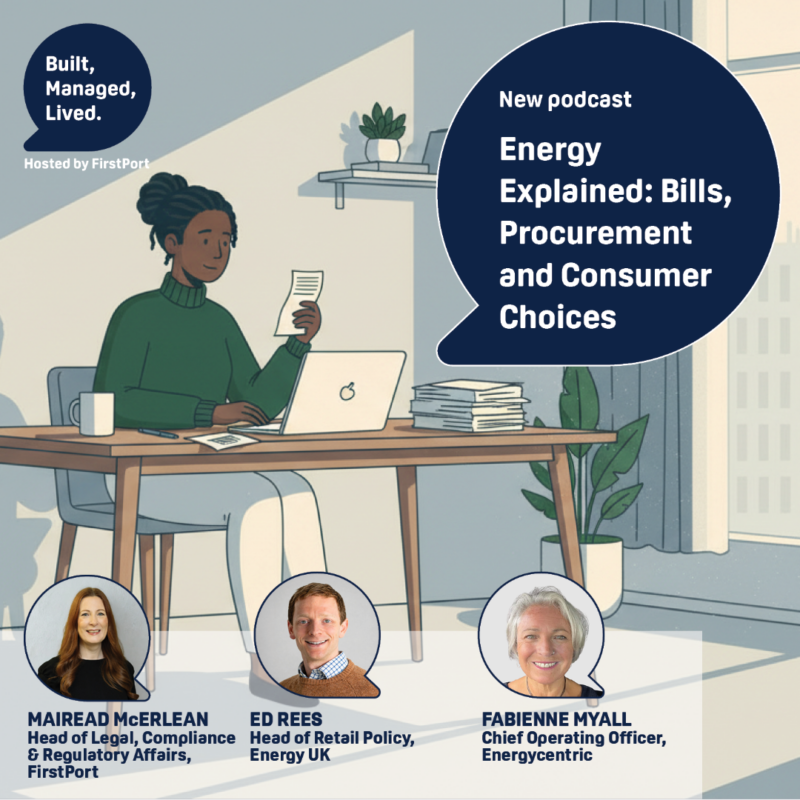
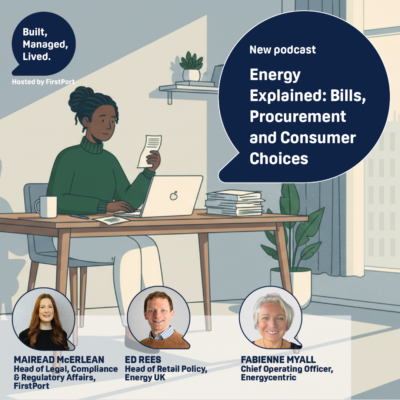
FirstPort's Mairead McErlean is joined by Ed Rees, Head of Retail Policy at Energy UK, and Fabienne Myall, Chief Operating Officer at Energycentric, to explore the current UK energy market and the challenges facing consumers. Together, they discuss the differences between energy procurement for individual homes and communal supplies in multi-occupancy developments, share practical guidance on energy billing and responsibilities, and examine the technologies, policy developments and renewable energy solutions that could help shape a more affordable, efficient and sustainable energy future.
Key Takeaways
Explore FirstPort’s YouGov research on energy affordability: FirstPort poll reveals how households are bracing for higher energy costs this winter

Head of Compliance and Regulatory Affairs, FirstPort
Mairead is Head of Compliance and Regulatory Affairs at FirstPort, where she provides strategic guidance on current and emerging legislation and regulatory frameworks.

Head of Retail Policy, Energy UK
Ed is Head of Retail Policy at Energy UK, leading policy development and stakeholder engagement across key issues affecting energy consumers and suppliers.

Chief Operating Officer, Energycentric
Fabienne is Chief Operating Officer at Energycentric, specialising in energy procurement and management services for communal and multi-occupancy residential developments.
Mairead: Hello and welcome to. Built. Managed. Lived. I’m Mairead McErlean, your host today. Today we’re going to be talking about energy. First port of recently commissioned a YouGov poll that shows 60% of households are concerned about rising energy costs. We’ve got two guests today, both with very different areas of expertise, who are going to help us pull together what’s going on in the energy market. So, I’m joined by Ed Rees from energy UK, who’s going to talk about the market in general and what consumers can do to help improve their understanding of energy costs and get the best deals. And I’m joined with Fabiene Myall from Energycentric. Energycentric specialise in procuring energy for multi occupancy blocks so that Fabienne will be talking about how energy is procured to power corridor lights, lifts, swimming pools, gymnasiums and all of those kind of shared features. Ed many households have seen energy prices rise recently. Can you give us a bit of an overview of the energy market in the UK and how that compares to energy markets overseas?
Ed: Yeah. Thank you. I think first of all, it’s very understandable that people are concerned about energy prices at the moment. They may have seen their bills go up recently, but they’ve also seen a lot of press in stories, in the news around bill rises that may be coming down the line in the next few months. So that is a concern in terms of the the wider question about where the market is. A bit about the comparison to international examples. We’re seeing another price shock, and we’ve seen one in 2022 after the war in Ukraine. And that pushed up the gas price. And the gas price is very internationally-driven trend which the UK is particularly vulnerable to. And that’s because we used a lot of gas in the UK. We use it to heat our homes, but we also use it to burn it to generate electricity. So, both the gas and electricity price rise when these sort of spikes occur, and the war in the Middle East has driven up prices again. So, the UK is struggling because, with higher bills, because we are particularly dependent on this gas. So compared to the rest of Europe or more internationally compared to the wider market, we see prices flow through to customers very quickly.
Mairead: I mentioned the YouGov poll, which FirstPort commissioned, that showed that 55% of people are interested in fixed tariffs. You’ve said that the market’s going to be volatile over to the next 6 to 12 months. Are fixed tariffs worth considering at this point in time?
Ed: It’s really interesting that figure, because actually only 40% of domestic customers are on fixed tariffs at the moment. The other 60% are on the price cap. And there’s some misconceptions around when the price cap does and what it does is it just limits the amount their supply can charge based on the amount of energy you use. It doesn’t actually cap the total amount of your energy bill. So, people sometimes think are overly reassured by the price cap. But as I said, that only gives you three months of protection before you then move on to the next round of cost increases when they pass through. So actually fixed tariffs couldn’t really protect you against some of these volatile periods. So fixed tariffs are a great step that customers can take. There’s a lot of innovation around tariffs. And there are things like tracker tariffs now which mean that they’ll lock you into a discount against the price cap. So, whatever the price cap level is they might they’ll provide a discount of say 50 or 100 pounds on that level. Currently there’s one thing alongside fixed deals that customers can look at to bring down their costs, and that’s access to cheaper periods of energy, and with more renewables on the grid, we’re getting more of these cheap periods of energy. So, you’ll see these as what are called time of use tariffs or standard tariffs that have, a demand turn up or turn down periods where they just offer you cheap energy at weekends or overnight. And that means you can then find other ways to save on your energy bill by utilizing these green periods on the grid, which actually bring down your bill.
Mairead: The thing with a fixed deal, Ed, is it gives you some certainty.
Ed: Yeah, yeah you can. As I said, as energy become, bills are becoming more volatile. This is a way to protect. And 40% of customers now are sitting on a protection through to the middle of next year or later next year. There’s even two-year deals that were available, from the spring this year. So, you could be locked in for a period of time.
Mairead: Thanks, Ed. That’s really useful. And I’m going to come to you and ask you about energy in multi occupancy buildings, because it’s given us a really great introduction there to options that consumers have for buying energy for their own homes. Tell us a bit about how energy is procured for multi occupancy buildings.
Fabienne: So, I think the main difference is around the speed at which the prices changes when you start talking about commercial contract. So, Ed talks about residential private contracts that you do at home. But we are looking at a commercial contract. And the commercial world moves very fast so we can have prices changes two, three times a day. We have had experience of prices that, while the contract is being signed, are being pulled because the market is reactive very fast to any event that is going on in the world, particularly geopolitical events. So that’s one of the big, big difference is the speed at which we have to capture prices.
Mairead: And Fabienne, can I just jump in there for a moment because you’re talking about commercial contracts and first manage residential buildings. Why do we have a commercial contract in a residential building.
Fabienne: So, the commercial contract is purely for the landlord areas that are considered as a commercial entity. So, for example, carparks, lifts, laundry rooms. Some properties have got gymnasium. So, all of those properties are considered as a commercial aspect of the development. So that’s what runs the building and therefore it is commercial.
Mairead: Thank you. I think that’s an interesting point to draw out, because lots of people would look at a block of apartments and say, well, that must be a residential supply, and in fact, it’s not. It is. All of those communal areas are supplied on a commercial.
Fabienne: Yes. That’s correct. And I think that’s the big difference with what we are doing, is that the, the procurement of commercial supply is very complex because there is all of those movements taking place. And that is why a lot of, commercial entities come to us to help them navigate the market and look at not only the best time to buy, but also the best product, because there are a lot of different products on the market. So, for example, when we look at, residential properties, we always try to go for a fixed contract. And the reason for that is for budget purposes. If you try to use flex contracts on these thousands of supplies, you are creating risk that is acceptable for some commercial supply, but is not acceptable for residential use.
Mairead: Can I ask you about something you mentioned a moment ago? Have you and you mentioned, for residential, that there is a preference for fixed price tariffs. And we know that because when we have to prepare budgets for buildings, we need to know exactly how much we’re going to be paying for certain bills in the upcoming year. But in residential leasehold, we can’t enter a contract for more than a year. Can you just expand a little bit about how that affects how we purchase energy?
Fabienne: Absolutely. So, this is one of the limitations that your industry specifically is working against. I don’t think anybody in this particular space at this time would want to enter in anything more than a 12-month contract anyway because of the volatility, but certainly in the past there has been missed opportunities when prices were really low to capture that and do extend it contract period. But unfortunately this is one of your industry regulations that limits it. It would be really useful at time with the market is in a really good place to be able to secure a longer contract. And I think that stability also would probably allow supplier to be a little bit, what we call sharpening the pencil a little bit when it comes to the bottom line of the cost of the contract. But yes, that’s something that we have to work again, that works against us.
Ed: Because the, the average contract length in the non-domestic space tends to be longer than in the domestic space. 3 to 5 year fixes are more common. And when you get to this sort of price volatility, you tend to see some of the longer terms being pulled. So as you say, anything that limits that is a bit of a problem and a missed opportunity.
Fabienne: It is a missed. It definitely is a missed opportunity.
Mairead: Thank you. Ed, can we talk about energy bills and what people see on their bills? Because that can be a bit confusing. And you’ve offered today to take us through, explain and help deal with some misconceptions.
Ed: Yeah. The energy bill is a bit complicated, and that’s partly because of the last 20 years of regulation have required suppliers to put lots of information on the bill. So if you look at it, there are lots of little boxes and lots of little different definitions of stuff that you need to try and understand. And that’s a bit of a shame that the energy bill has become this sort of bit of a beast. And actually there are easier ways to understand your energy costs. A lot of people have smart meters in homes now, and you have your in-home display, or you’ll have an app which can help show you your energy use. And that’s a really good thing to stay on top of, because then you can understand what sort of deal will work for you. And there are a couple of things to think about in terms of your key terms around energy use. One is your standing charge and the other is your unit rate. And it’s really important to sort of understand the difference so that you can work out which deal is going to work best for you. And standing charge is the amount you get charged every day. Whether or not you use any energy and the unit rate is just what you get charged for every bit of energy that you use. And so, the deals are structured based on these two components. And if you tend to use a lot of energy, the unit rate comes into play a lot more because it means that you’re going to be charged that unit rate more times. Whereas if you’re a low user, the standing charge is really the important thing to look at. So, the energy deal’s structured differently based on these two things. So, although something might be cheap for one person, it might not be cheap for somebody else. So you really need to understand your particular use and to understand these two components to work out which deal is going to work for you. So, they’re kind of, two key terms on your bill to look at. But then there’s also these off-peak periods that I talked about before when the grid’s green and there is cheaper energy available. And making sure you have access to these sorts of periods can be really helpful for all customers, because anyone can, who’s got that option to change when they use their devices can help save. So, these are sorts of things to look out for. And on the bill it will say something around the alternative tariffs available to check you’re on the best tariff with that supplier. So, you can have a look on your bill and you can see a suggested other tariffs. And you can then see clearly if you could be saving money with that supplier. So, bill is worth looking at. But then there’s also the apps and the smart meter to help understand what’s going on. And if that still doesn’t make sense, then speak to your energy supplier or consumer group like Citizens Advice can help explain those terms.
Fabienne: And what I think really important there. The point you’ve made about the standing charge and unit rate, that is the same in our world. You know, when we look at prices and revalidate prices, we have to look at that. It’s not the same for everybody. So that is also part of our contract and the thing that we have to take consideration.
Fabienne: I think the problem with the invoices is some years ago, there was a big drive to make everything transparent, and it’s got so transparent that it got overwhelming and you can’t decipher anymore, what is important. They’ve almost – the volume, the sheer volume is instead of taking it to transparency, it’s made it even harder to see what is happening on your invoices.
Ed: I completely agree, I think simplicity in the communication is really key, and that’s why you should be allowing the apps and the smart meter displays to really just prioritise the right information for customers so they can see the key bits of information that they can then use to take to price comparison site or to suppliers website to look at what the best deal is for them.
Fabienne: And we have the same drive on the commercial world, of doing big, projects to change meters all the whole legacy meters, the to replace them with either half-hourly meters, AMR meters, smart meters for the same reason, because the more data you have, the more you can utilise that to get the best prices that you can, that you can have. So, there is a lot of parallels between the two worlds.
Mairead: You’re both collecting as much data as possible. But perhaps we’ve reached a point where giving too much data actually causes confusion, rather than making the situation clearer.
Ed: Yeah, I think it’s great that smart meters and other types of commercial meters provide that data to the supply, though, and so more data is better there because then suppliers can understand what the customer’s doing. So, are they are they, using their energy at peak times or are they under consuming their energy? These sorts of signals are really important for supplier to help understand what they can offer the customer in terms of the best tariff or additional support to help them.
Ed: So smart metering is a really fantastic tool for every domestic customer and really should be looking at getting those in homes to help you budget if you are concerned about your energy.
Fabienne: And nobody wants an estimated bill. Nobody wants to overpay or even underpay because at some point it’s going to catch up. And if you are, you know, if you move, if you go from a short-term tenancy, you know, and you’ve been billed on estimate and it’s incorrect, you know, it catches up with you at some point in ways that you can maybe have budgeted for, so nobody likes an estimated bill.
Ed: Nobody really wants to spend their time talking to their supplier, right? They want to have it right first time, and that’s an easy way to avoid having to make those calls and doing that. Life admin of sorting it out. So, actually just getting it right first time, is everyone in everyone’s interest.
Fabienne: Absolutely.
Mairead: There’s a couple of things to draw out there. Billing issues, estimated bills moving home. And also you mentioned, Fabienne, people who are on short hold tenancies or short-term tenancies. Ed there’s lots of questions in there for you that what can people do? Let’s start with people who own their own homes, and then if you wouldn’t mind talking a little bit about what people who are renting a home can do.
Ed: Yeah. So, if you’re the bill payer, you’re in control. That is the key message across the piece. So, who the contract is with, whether it’s the landlord or the tenant, is the key person that supplier will engage with. And you have a lot of rights as the bill payer. You can get your meter changed, you can get one of these smart meters, which is which is key to helping them understand energy use, and you can also then pick the tariff that you’re on. So, it really depends on your setup depending on whether or not you are the bill payer. But also it’s worth telling your supplier who’s in the property, because if you do have anyone who’s vulnerable or has any additional needs, the supplier can register you onto the priority services register, which can be very helpful if there are power cuts or if there are, you need to maintain supply in your property for any reason, or you need any additional ways of explaining your bills, such as Braille versions of bills or additional language versions of bills which can help a customer to understand. So, it’s worth speaking to your supplier, ensuring they have the right information about you so that they can help tailor their service, to what you need.
Mairead: So, if you were renting a property and you’re, you’re moving in, is it on you to contact the the supplier or should your landlord be contacting the supplier? How do you know which supplier to contact?
Ed: Yeah that’s a good question. Change of tenancy is a real problem area in energy and a lot of the debt problem. You may have seen stories about it in the press, but actually consumer energy debt has risen massively over the last five years. And that’s been driven by one by affordability problems is a key driver, but also the confusion around when you change property, ensuring that the supplier has the right contact details to the person that property and is billing it effectively. And you don’t want to be dealing with your supplier, as we say. So you want to sort of minimize that contact and the way that the bill payer can ensure that they have a good experience is by collecting the relevant data, which is checking the meters ahead of moving out of a property, checking the meters when you move into a property, and then contacting the supplier as soon as you as soon as you are able once you’re in the property as the bill payer. So, whether or not you’re the landlord or the renter, depending on your relationship and your responsibility for the bill, but for everyone, I’d suggest it’s worth taking those readings, whether you’re the landlord or the renter, to any challenge or problem depending, you know, it might not be your fault. The person moving out might have left a load of debt and unpaid bills. So, you really want to protect yourself against that exposure to paying some of those costs, and the way you can do that is just by taking pictures of your meter when you move in or move out and then supplying those to your supplier.
Mairead: Thank you. Looking ahead to the the future of energy and you’ve already touched on it’s going to be volatile for a little while. What do you think are the biggest developments that are coming down the line, and what will be the big impacts from those, you know, do you want to go first?
Ed: Yeah, I think the current gas price spikes are driving projections for future bills to be to be high, very high, you know, comparable to the amount consumers are paying in the last crisis. So that is the sort of short-term trajectory. However, you know, resolution in the Middle East could really help things and reduce prices. So, it’s a very uncertain time and bills could go in sort of any direction. But what we’ve seen is this trend, the sort of medium-term trend for more volatile and crisis to occur. So, you know, when there are cheaper deals and there are opportunities to lock in good deals, that’s something that consumers should be looking at and trying to take advantage. In terms of, you know, ways of managing this this winter, I’ve pointed out things like the looking at off peak periods, which are important. And we’re also calling on governments to introduce some additional support to this winter because of the scale of the crisis. And that could take a number of forms. Some of it might be some universal support, and there’s been discussion about moving some of the levy costs, the policy costs for, for various government initiatives off, off the bills. And that might be for domestic as well as non-domestic. We think it’s really important that non-domestic bill costs come down as well, because that passes through to domestic customers as well through some of their services, like in residential properties. But then there’s also more targeted interventions for low income and vulnerable customers, which we think are really important because those are the ones who aren’t managing currently with high prices and are, and it’s leading to a lot of energy debt. We’ve talked about energy debt a little bit, but it’s now at around 6 billion pounds, up from about 1.75 before the Ukraine crisis. So actually, we need to address this and we need to be more preventative at addressing debt. And that means bringing down bills and making them more affordable for certain customers.
Mairead: Fabienne, on your side of things. What do you think the, you know, the big changes or big impacts will be in the commercial sector
Fabienne: In the commercial sector, apart from the price, the volatility, as we know, we used to go into a contract period hoping to beat the previous year. Now we’re just trying to limit the increases. So that has changed. It’s changed the way we are. Procurement strategy has changed. So we always start a procurement, for a 12 month contract on the first day of the contract for the previous year starts. So we already started 12 months in advance because we want to be able to target these any time where there are prices drops, we want to be ready to go. But the thing for us, it’s going to be about data. We’ve spoke about the the drive for smart sorry smart meter, AMR meter, half hourly meters. And this is because the industry is trying to balance consumption, ensuring that there is energy constantly available for everybody and that balancing work that they do, is quite costly. It’s where we pay a lot of non-commodity cost. But this is where the drive for the data will then make it a much more efficient business. And when the industry is more efficient than hopefully that will stabilise the price. They won’t bring it down, but they’ll stabilise, it might not be as volatile if they can balance it a little bit better.
Ed: And in terms of balancing for a domestic customer, there are things they can do. I’ve talked about flexible tariffs, but there’s also batteries. And there’s things like balcony or plug in solar, which is now available in the UK to plug in so you can access some of your own generation and some of your own storage. And that enables customers to be more flexible so that you can use it’s a sort of store up your energy when it’s cheap, and then you can use it whenever you want. So, it means you don’t actually have to change your behaviors in the home at all, but you can then access this cheaper energy which is closer to home. It’s clean and will help balance the grid, so accessing cheaper prices that way.
Mairead: We’ve talked a lot about, energy costs, energy bills, but something else that’s really important to a lot of people in regard to energy is green energy, and you’ve just mentioned solar panels, etc. Can you talk a bit about where green energy is going in this country?
Ed: Yes. So the government has made some very ambitious plans to move to more stable, resilient generation and move away from gas. And that’s paying dividends in the UK. So, currently gas still sets the price for electricity quite a lot of the time. But by 2030 that, that exposure to gas costs is going to significantly decrease. So bills are going to become more stable and less susceptible to this volatility because we have this great sources of green generation. There’s scale generation, but there’s also a lot more, private domestic, generation, which is which consumers are taking up. There’s also the important corollary to that is, energy efficiency improvements in homes and looking at ways to reduce energy costs because it’s always cheaper and the greenest to just not use the power where you can. And so you can make your energy go further that way. So, these are the sorts of changes which are going to be necessary to move and reduce that gas exposure. But they are bringing down bills now and they will make a big difference in the next few years.
Fabienne: And at the moment, for a for us in the commercial work, green energy is more expensive. So you have to balance the strategy in the responsibility that we have between the environment and the end user need to have a cheaper bill. So, when we do a procurement strategy, one of the first things is what is the appetite towards green energy? And the if there is a middle person, they’ve got to make that decision about balancing the need of those two things.
Mairead: And outside of energy that’s procured for multi-occupancy buildings where ultimately the cost is picked up by people who live in those buildings. But in a more general commercial context, are you noticing any changes there as the the need for big organisations to report on their carbon footprint?
Fabienne: Absolutely. That has changed a lot. But equally, they work in a very different sphere. So, for example, if you’re manufacturing, you can manage your consumption a lot better because it is stable. You work between those hours. You know how many machines you are using. So you have something that is stable. What you can then do is you can benefit from a flexible contract, which allow you to purchase energy as and when for smaller period of time. But it’s a very complex process and there is no certainty with that approach. So, it only really works for those commercial big commercial enterprises that do manufacturing, etc. they’ve got these kind of products that suppliers provide which are different.
Mairead: Thank you. Final question. There was one thing you want listeners to take away from today. What would it be?
Fabienne: I think I’ll leave you to do the indication of what people can do from my perspective is that when you see the prices on your bill for your commercial part, you know that feed into your service charges, what I think I want people to understand is the amount of work behind it and amount of people who got involved into trying to get those prices. I think very often, people think that, you know, we’ve just gone and get a price and not really thought about the person behind paying the bill, but actually, there is a lot of work of validation to ensure that we get this right.
Mairead: Thank you. Ed.
Ed: I think the message I like people to take away is that there is a lot of help and support available to customers this winter. It can be really sort of worrying to hear all the news reports about the costs of energy and the impact is having on people. So, speaking to your supplier is the best first port of call for all customers. But there are also other routes in to your supplier. As I’ve mentioned already, people like this and advice and other advice helplines are available to help that engagement. And there’s a lot of, things they can do sort of support schemes available to reduce your costs. There is a, you know, I’ve talked about the debt problem and a lot of customers are in debt and 75% of that is unsecured. So there’s no repayment plan in place for those customers. But if you do have a debt and you want help with it. There are a number of suppliers schemes, such as a ‘You Pay, We Pay’ scheme, which means that if you contribute to your debt, your supplier will also pay towards that debt to bring it down. So together you can help bring that that cost down. So really it’s about starting that discussion with your supplier. And then they can get the help and support to better deal with this crisis.
Mairead: Thank you both so much for coming to talk with us today. It’s been really interesting and I hope people do take away those points. So Ed, Fabienne, thank you so much for joining us and to our listeners or viewers- until next time, thanks very much.
Be part of the conversation
Have a perspective on how homes are designed, managed or lived in? We’re always looking for new voices to join the conversation.
Explore our latest conversations about residential property management
Never miss an episode
Join us on Spotify and Apple Podcasts for fresh conversations, stories, and insights.
Get in touch to learn how our range of residential property management services can support your development.